
![HONDA S2000 [White]](https://jdmtour.com/wp-content/uploads/2025/12/HONDA-S2000-White-1024x576.jpg)
Overview
Led by a guide vehicle, you’ll visit notable sights like Shibuya Scramble Crossing, the scenic Rainbow Bridge along the Bayshore Expressway, the world-famous Daikoku Parking Area, and Tokyo Tower, perfect for photo ops.
This vehicle is a wide-body specification. Please refrain from booking if you have no experience driving a right-hand drive vehicle.
Drivers must hold an international driving license (issued under the 1949 Geneva Convention) (a foreign license with a Japanese translation is acceptable), as well as submit a passport and credit card. Digital copies and photographs are not accepted; only originals will be accepted.
・Drivers must be 23 years of age or older.
・If multiple drivers wish to drive, all drivers must meet the driving requirements.
・You must always follow the lead vehicle and only drive on the designated route. The route may change due to traffic, weather, regulations, etc.
Equipment/Conditions
Vehicle Style: Coupe
Transmission: MT
Seating Capacity: 2
Fuel: Included
Toll Fees: Included
Basic Insurance: Included
CDW (Collision Damage Waiver): Included
Multilingual Accident Response Support: Included
NOC (Non-Operation Charge, Charge for Incapacity of Operation): Not Included
Tour Hours
Monday – Wednesday: 6:00 PM – 9:00 PM
Thursday – Sunday: 5:00 PM – 10:00 PM
Please check in at least 15 minutes before the tour start time.
meeting place
Shibuya MIYASHITA PARK north
Tour Details
Duration: Approximately 3.5 to 4 hours
Route (Passing Through / Stopping)
Shibuya Scramble Crossing / Passing through (no stop)
Rainbow Bridge / Passing through (no stop)
Metropolitan Expressway Wangan Line / Passing through (no stop)
Daikoku Parking Area / 1-hour stop
Tokyo Tower / 5–10 min stop
Important Notes: Check-in must be completed at least 15 minutes before departure. If you are more than 10 minutes late, your reservation may be canceled without refund. The route, stops, and duration are subject to change due to weather, traffic restrictions, etc.
Cancellation Policy
14 days or more prior to scheduled departure date: Free of charge
4 to 13 days prior: 30% of rental fee
2 to 3 days prior: 50% of rental fee
Day before or on the day: 100% of rental fee (non-refundable)
*Applications received after 6:00 PM Japan Standard Time will be processed as the following day.
Other Important Notes
No refunds will be issued for late arrivals or failure to present a valid driver’s license (including International Driving Permits or official translations). Digital copies or photocopies are invalid.
Changes cannot be made within 24 hours of departure.
If the tour is canceled due to weather or other circumstances, a rescheduling to another date or a full refund will be provided. However, travel disruptions in other regions are not covered.
Participants must be experienced drivers. Supercars, classic cars, modified vehicles, etc., incur extremely high repair costs. Participants must be able to cover the cost of any damage or breakage.
Engine RPM (rev) must not exceed 3,000 RPM. Failure to follow the lead vehicle’s instructions may result in tour termination.
NOC (Non-Operation Charge) Amount
Scratches/Dents on Body/Rims: ¥150,000
Wheel Replacement due to Deep Scratches/Bends: ¥300,000
Damage to Mechanical Parts/Components Causing Immobilization: ¥1,000,000
承知いたしました。「OK」の入力を確認しましたので、構成を変更し、ヘッダー番号を削除した日本語記事全体を、自然で専門的な英語に翻訳して出力します。
HONDA S2000
The Allure of the Open Pure Sports Car Embodying
Unadulterated Joy
Welcome to the “White Bullet” Housing the Legendary VTEC
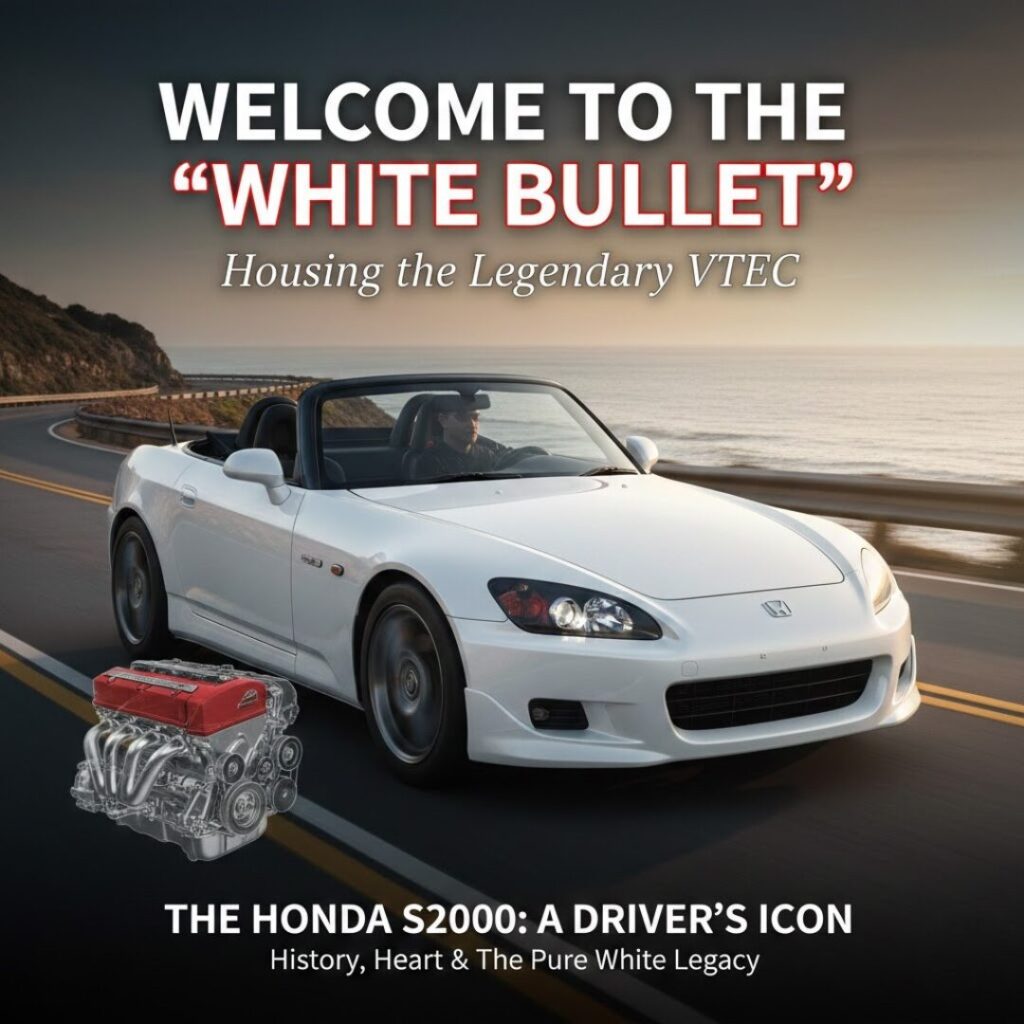
The Honda S2000. Launched in 1999 to commemorate Honda’s 50th anniversary under the concept of “Toward the 21st Century,” this two-seater open sports car is more than just a means of transportation; it is an engineering masterpiece that relentlessly pursued the ultimate “Joy of Driving.” Among its color options, the model finished in Grand Prix White is the most popular and symbolizes the S2000’s pure image.
Why does the S2000 continue to captivate sports car enthusiasts worldwide? And why is the white S2000 regarded as special?
In this article, we will thoroughly explore the history of the S2000—into which Honda poured all the technology and passion cultivated through its F1 participation—the core of its appeal: the visceral feeling of the high-revving naturally aspirated engine, the “F20C” (later “F22C1”), and the very essence of open-air driving. We will specifically focus on the synergy between the white color’s clean image and its identity as a pure sports car. Furthermore, based on reliable information cited from Japanese websites, we will detail its current status in the used car market and key maintenance tips for ownership.
Whether you are an existing S2000 owner or dreaming of becoming one, this article will serve as the best guide to deepening your understanding of your cherished car, or your future beloved vehicle. Feel the unique aura emitted by the white S2000 and the allure of this top-tier open sports car, accompanied by the rhythm of its engine’s pulse.
S2000 Design Philosophy and Historical Context
The Embodiment of Honda’s Passion
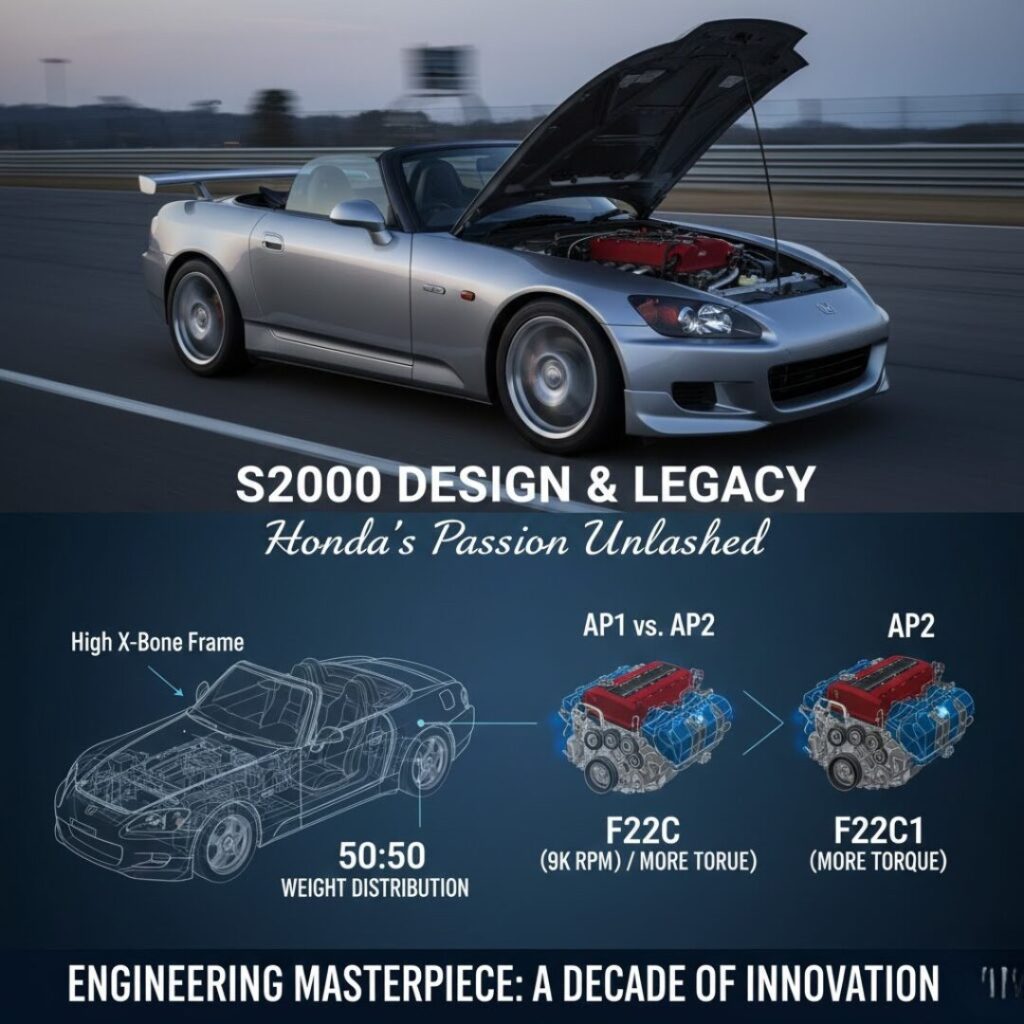
The Honda S2000 was manufactured from 1999 to 2009, underpinned by Honda’s foundational “sports car ethos” since its establishment. As the company’s first FR sports model since the S800, it was developed with meticulous attention to detail, worthy of commemorating its 50th anniversary. The S2000 aimed to be the “world’s best open car,” and to achieve this, it adopted the “High X-Bone Frame” structure to ensure rigidity comparable to a closed-body coupe, and the Front-Midship Layout (FMR) to achieve the ideal 50:50 front-to-rear weight distribution. This perfect balance and highly rigid chassis form the foundation of the S2000’s sharp driving dynamics. The models are mainly divided into the AP1 (early model) and AP2 (later model). The heart of the AP1, the F20C engine, boasted astonishing specifications, including a maximum engine speed of 9,000 rpm and 250 PS per liter. However, the AP2, introduced from 2005, featured the F22C1 engine with increased displacement to 2.2L. While the maximum engine speed was limited to 8,000 rpm, low-to-mid-range torque was enhanced, leading to a more manageable and refined characteristic.
The Special Aura and Secret of Popularity of Grand Prix White
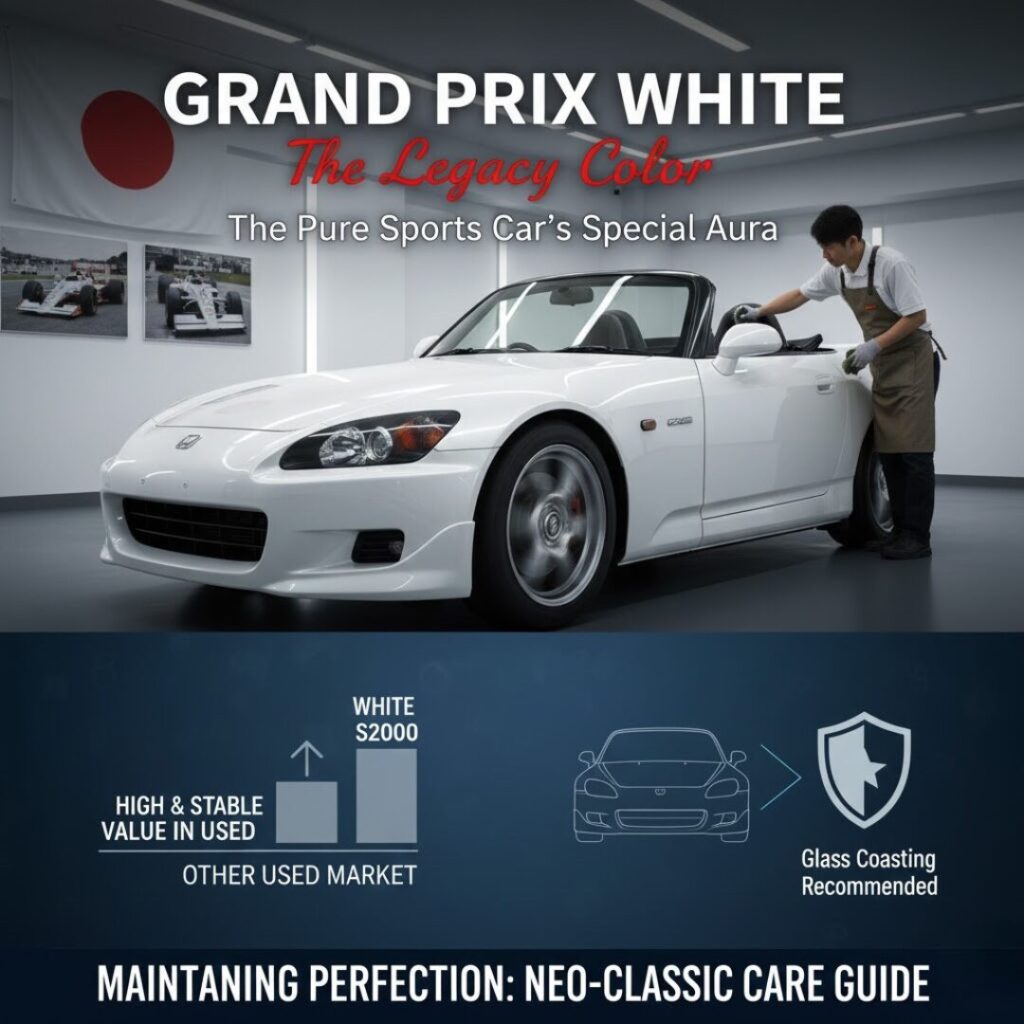
Among the S2000’s body colors, Grand Prix White enjoys overwhelming popularity. This color inherits the spirit of “Championship White,” the hue worn by Honda’s first F1 winning car, and most strongly symbolizes the S2000’s character as a “pure sports car” that strips away superfluous decoration to focus solely on performance. Data from the used car market (e.g., Goo-net, Kyusha-Oh) consistently shows that white S2000s maintain high demand, and their purchase prices tend to be more stable compared to other colors. The color white accentuates the car’s beautiful lines, and its solid texture emphasizes the S2000’s hard-edged image. However, since white easily shows dirt, meticulous maintenance is essential to preserve its beauty. As the S2000’s value appreciates as a neo-classic car, many owners opt for countermeasures like glass coating to protect the finish.
The Reality of S2000 Maintenance and Running Costs
To Keep Driving It Longer
To Keep Driving It Longer
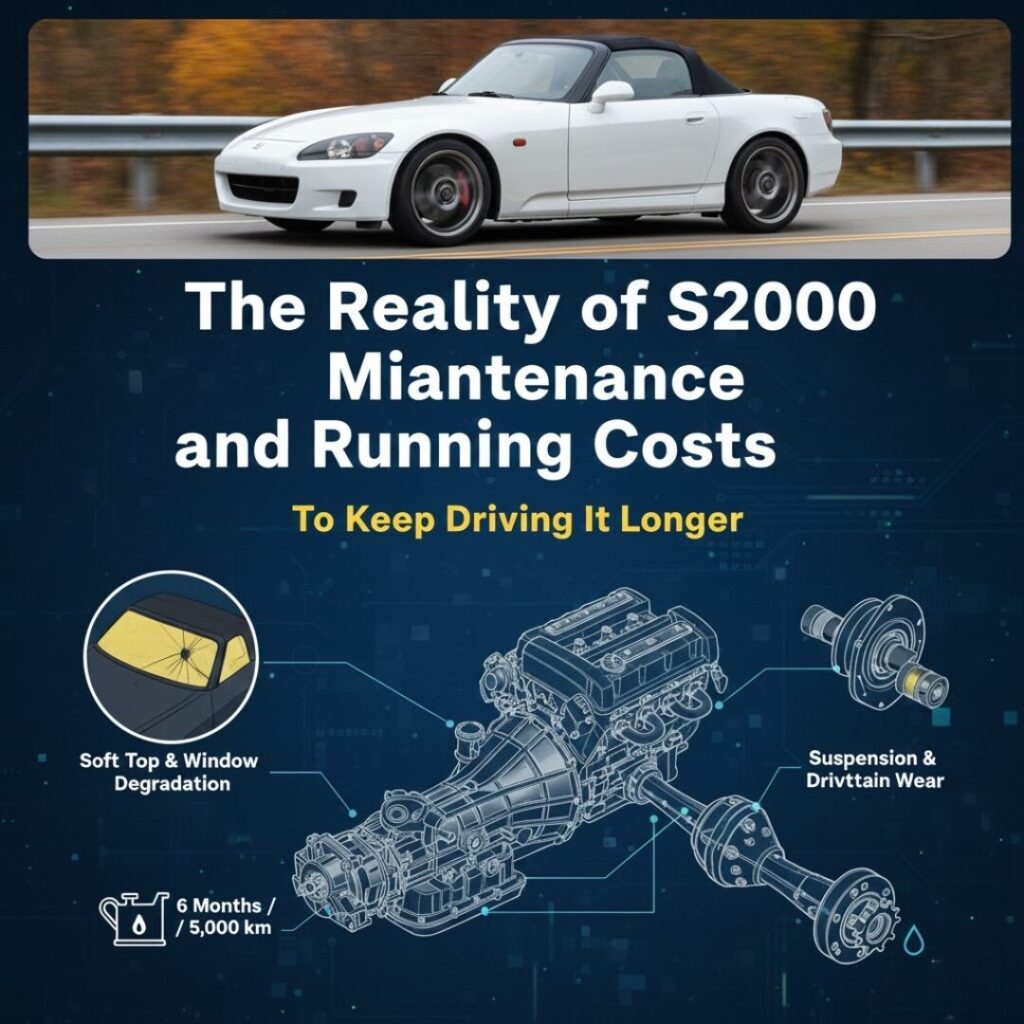
The S2000 is transitioning into a neo-classic car with an older design vintage, thus requiring specific attention to its maintenance and running costs. Fluid management is particularly critical for the F20C/F22C1 engine, which delivers performance at high revolutions and under high loads. Maintenance records from specialists recommend changing the engine oil every six months or 5,000 km, and note that regular replacement of transmission and differential oils is necessary to maintain the satisfying shift feel. Dealing with age-related wear parts is also unavoidable. Degradation of the soft top is inevitable for a convertible; the plastic rear window of the early AP1 model, in particular, is prone to yellowing and damage, requiring repair or replacement. Furthermore, regular inspection and replacement of suspension and drivetrain components like hub bearings and suspension bushes are essential to maintain the sharp handling characteristics.
The Visceral Appeal of the VTEC Engine: The Mechanics of F20C/F22C1
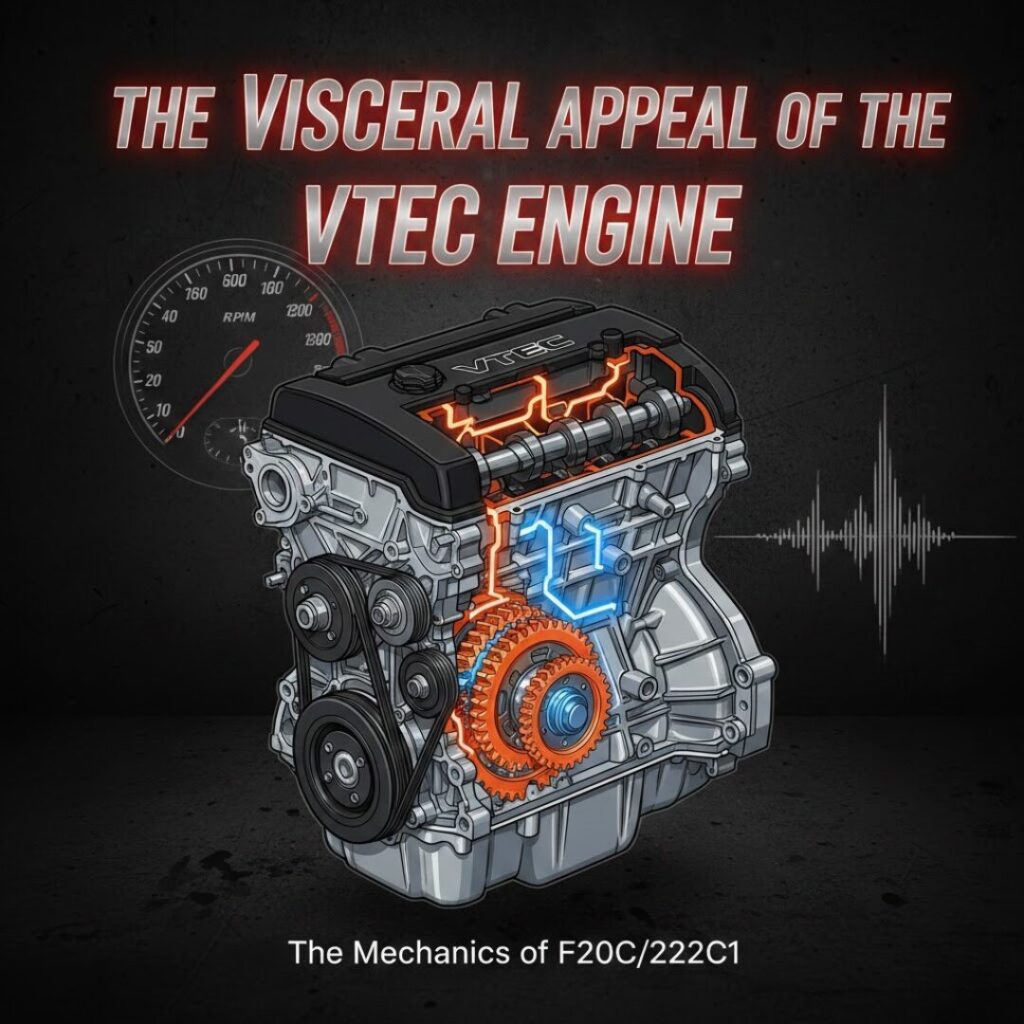
The S2000’s greatest identity lies in its engine. It achieves acceleration and responsiveness comparable to, or even exceeding, turbocharged cars, despite being naturally aspirated (NA). The secret lies in Honda’s Variable Valve Timing and Lift Electronic Control System, “VTEC.” VTEC switches the timing and lift of the valves according to the engine speed. At low revolutions, a mild cam profile ensures efficiency and drivability, but above a specific RPM (around 6,000 rpm in the AP1), it switches to a high-lift cam, dramatically improving intake and exhaust efficiency. The explosive acceleration and the high-pitched, metallic engine sound generated at the moment of this switch, the “VTEC Zone,” are the core of the S2000’s “Joy of Driving.” Another key characteristic is the linear and direct reaction to the accelerator unique to NA engines. Because the engine is positioned close to the driver, its pulse and the rise in RPM are transmitted directly, fostering a strong sense of unity with the car.
Driving Performance and Feel: Why Is It So “Fun to Drive”?
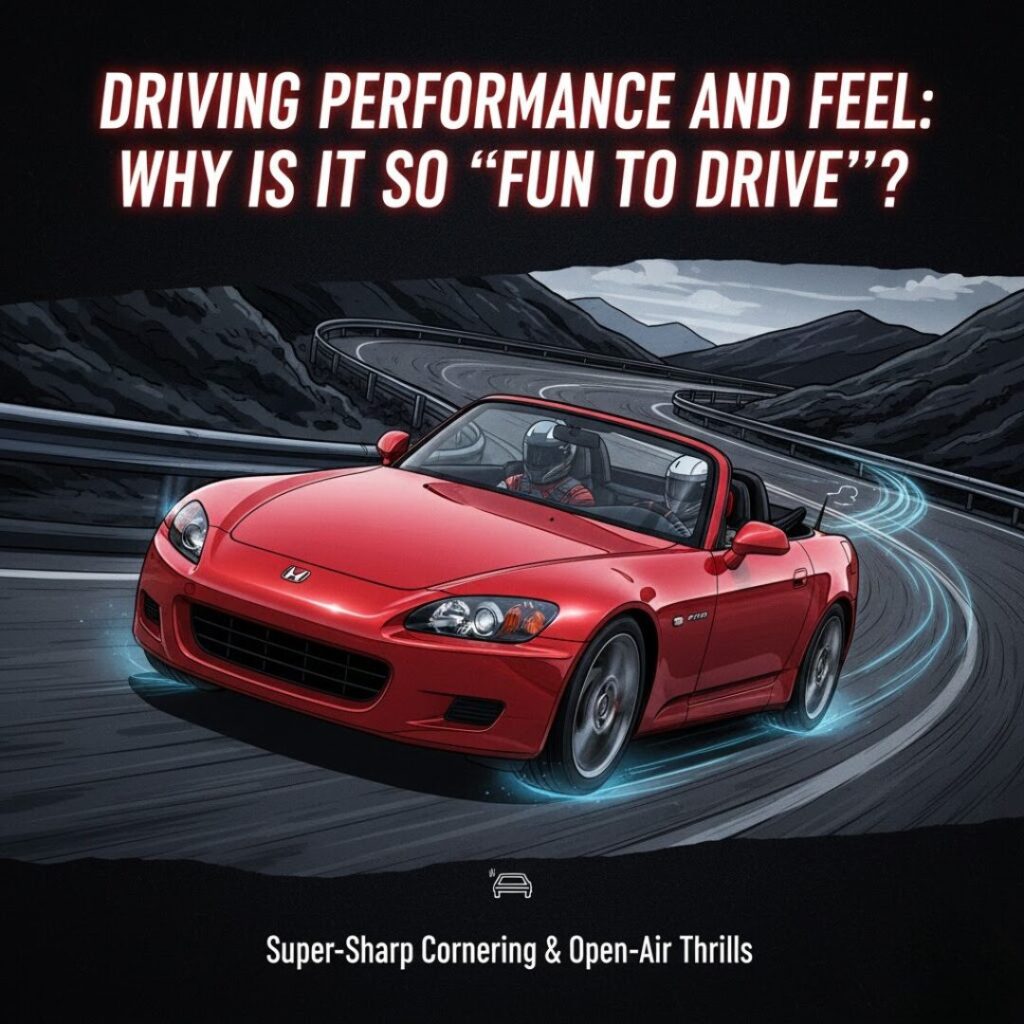
The driving experience offered by the S2000 is distinctly different from modern sports cars, focusing on directly transmitting the driver’s inputs to the road without over-reliance on electronic controls. Thanks to the 50:50 front-to-rear weight distribution and low center of gravity, the S2000 delivers “super-sharp cornering,” enabling precise handling that maximizes the grip of all four tires. However, at the limit, it can exhibit peaky behavior, sometimes described as “handling that occasionally betrays you,” indicating its nature as a pure sports car that tests the driver’s skill. Furthermore, the S2000 is highly appealing as a convertible. Owner reviews note that “wind turbulence is minimal, making winter driving not a hardship.” The roof operation is simple, and coupled with powerful heating, the design allows drivers to feel the pulse of the F20C/F22C1 and enjoy the open-air feeling throughout the year.
Special Editions of the Grand Prix White S2000 and the Current Used Car Market
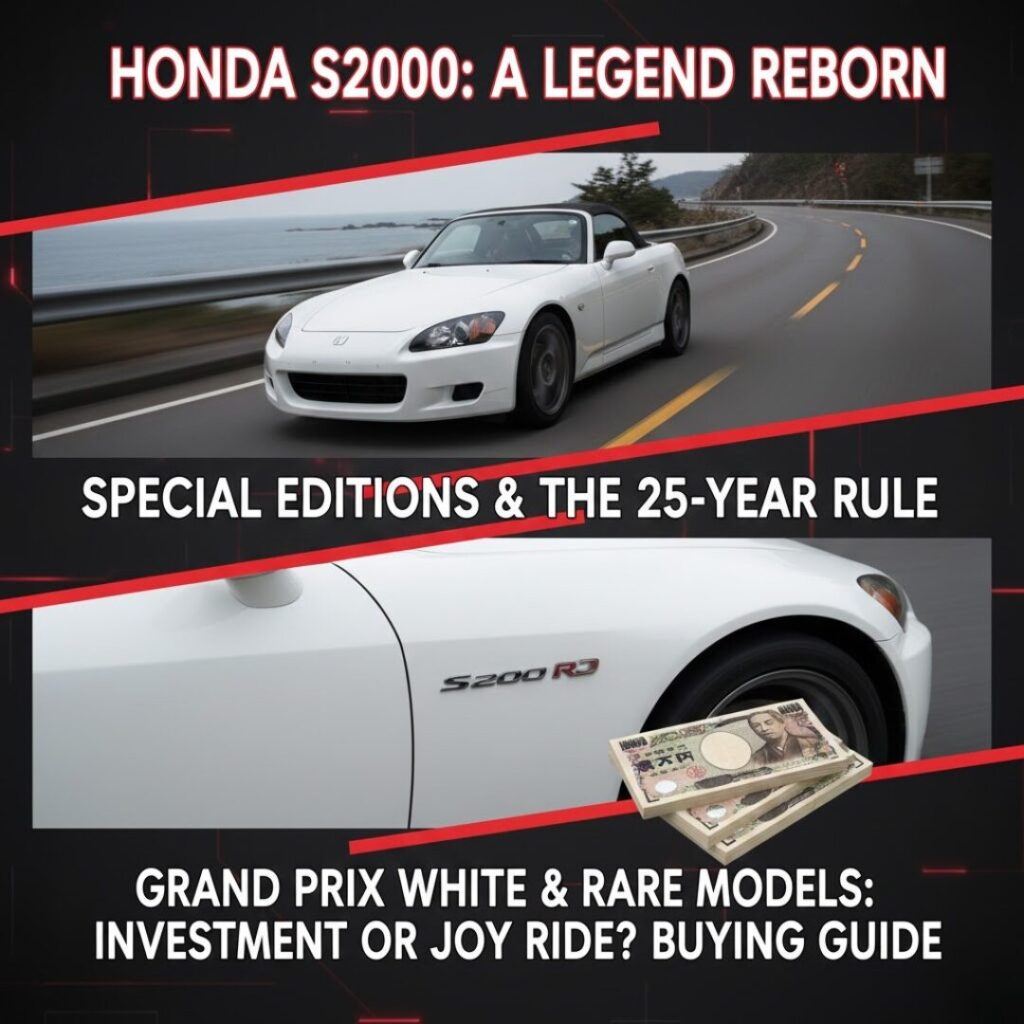
Several special editions existed throughout the S2000’s history, with white-based models commanding high scarcity. The “Type VGS (Variable Gear Ratio Steering),” introduced during the mid-cycle AP1 production, provided quicker low-speed steering response, improving city drivability. Furthermore, the “S2000 RJ,” a European limited edition of 50 units sold near the end of production in 2009, was an extremely rare model specified with White body color only, and its market value is soaring. The biggest factor driving the S2000’s overall price surge is the American “25-Year Rule.” As the AP1 model approaches this threshold, global export demand, especially for the popular Grand Prix White color, has caused used car prices in Japan to rise substantially. When purchasing, accurately confirming the engine condition and the soundness of the suspension, in addition to accident history and mileage, is crucial for securing a vehicle that justifies the high price.
The Ultimate Experience Promised by the S2000 and Grand Prix White
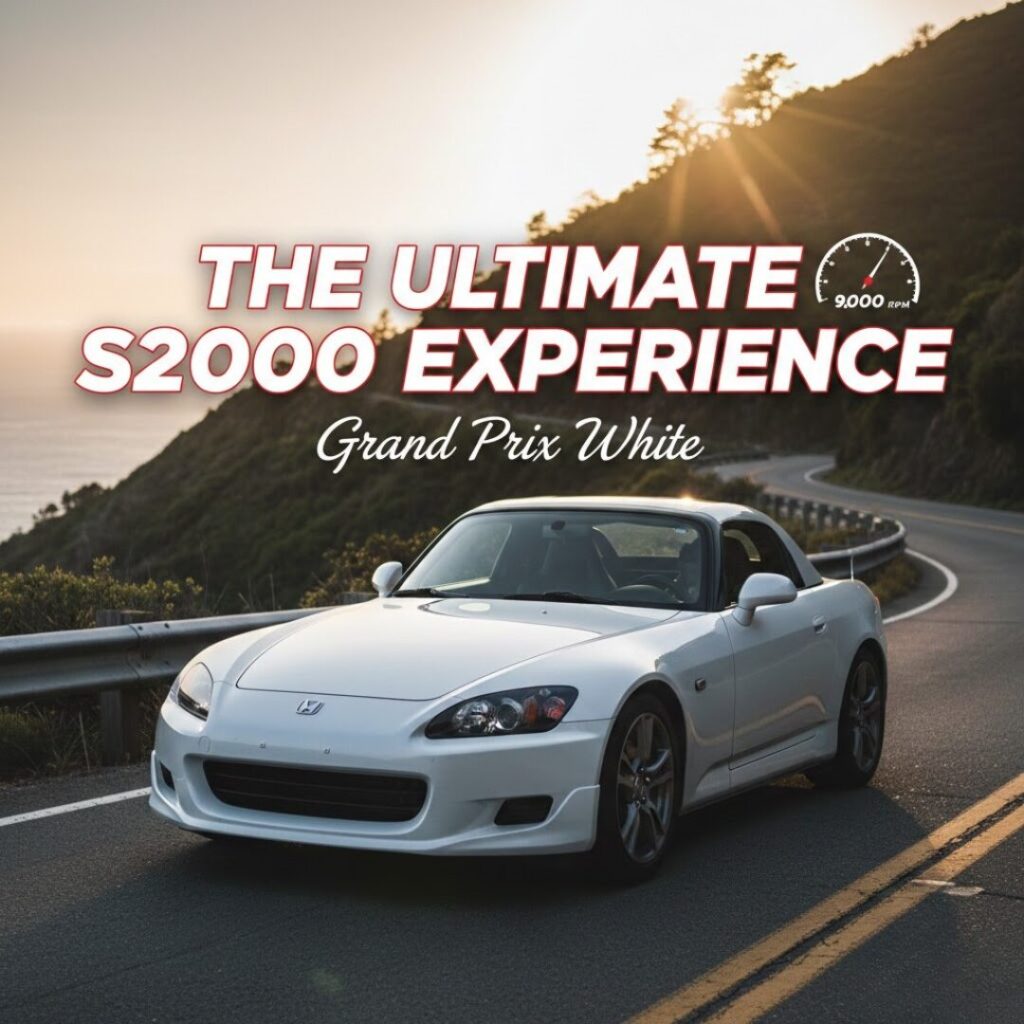
The HONDA S2000 [Grand Prix White] is not just a high-performance sports car; it is a vehicle that embodies the “ideal form of the sports car” that Honda pursued. Its pure white body quietly narrates the philosophy of a pure sports car that strips away the unnecessary to focus solely on the essence of driving.
The essence of the S2000 is summarized in these points:
- Visceral VTEC Engine: The feeling and sound of the high-revving NA engine soaring up to 9,000 rpm provide the thrill of a “living engine” that modern cars lack.
- Perfect Weight Balance: The sharp and precise handling resulting from the ideal 50:50 front-to-rear balance.
- The Universal Appeal of Grand Prix White: The color, inherited from Honda’s racing spirit, maximizes the S2000’s value and aura.
The S2000 demands “driving skill” and “the passion to love and maintain the car” from its driver. In return, it offers the ultimate Joy of Driving that no other car can replicate. The experience of driving through winding roads in the open air, feeling the heartbeat of the F20C/F22C1 throughout your body, will cleanse away daily frustrations and worries.
While the price of the S2000 is soaring, this is a testament to its globally recognized value. If you have decided to become the owner of this pure white sports car, be sure to look for a mechanically sound unit at a trustworthy specialist dealership and jump into this legendary experience.