
The First Step to Avoid Mistakes When Renting a JDM Car in Japan
Renting a JDM car in Japan is not just about getting from one place to another. The real appeal is being able to experience iconic Japanese machines such as the GT-R, Supra, RX-7, GR86, and Type R on the roads where that culture was born. But in practice, this is very different from booking a standard rental car. License requirements, age limits, manual-transmission rules, insurance coverage, and route selection are where many travelers run into trouble.
For overseas visitors in particular, the biggest concerns are usually things like whether an international driving permit is really enough, which companies actually stock JDM models, and what to watch out for if you plan to drive around Hakone or the Mt. Fuji area. If you book without clearing up those points first, you can end up being denied the car at pickup, paying far more than expected, or ruining an important part of your travel itinerary.
This article is for people considering a rental JDM car in Japan and want a practical, full-picture guide before booking. We will cover the license rules for foreign drivers, the kinds of cars that are easier or harder to rent, realistic price ranges, common mistakes, the best regions to drive in, and recommended services at the end. If you want more than just “where to rent,” and instead want to understand how to enjoy the experience without regret, it helps to get the full picture first.
Is Rental JDM Car in Japan Actually Possible? Start With the Conclusion
Yes, renting a JDM car in Japan is absolutely possible. There are real services offering models such as the GT-R, NSX, Supra, RX-7, AE86, and Lancer Evolution, and in areas near Tokyo, Hakone, and Mt. Fuji, some providers actively market the experience as a core part of JDM tourism. Fun2Drive, for example, has built its brand around JDM driving experiences in the Hakone area with cars such as the GT-R, NSX, Supra, RX-7, and AE86. Omoren also operates a broad lineup of sports cars and manual-transmission vehicles in Japan.
What many people get wrong, however, is assuming that any major rental chain in Japan will have cars like the R34 GT-R or RX-7 ready to book. In reality, the easier-to-rent options at large rental companies are usually newer sports models such as the GR86, GR Yaris, MX-5 Roadster, or Fairlady Z. Rare, older, or high-value performance cars are much more likely to be found through specialist operators. Toyota Rent a Car lists GR86 and GR Yaris class options, and Nissan Rent a Car lists the Fairlady Z.
The experience is different at major chains and specialist operators
The strength of large rental chains is convenience. Booking is easier, coverage terms are clearer, store networks are wider, and vehicle maintenance is generally consistent. Specialist JDM services, on the other hand, offer a much stronger sense of authentic enthusiast appeal. If you are traveling to Japan specifically to drive something like a GT-R, RX-7, AE86, Silvia, or Lancer Evolution, specialist operators are usually where those dream cars are more likely to exist.
“Available to rent” does not mean “available to everyone”
This is the most important point. High-performance cars and manual-transmission vehicles often come with stricter requirements than standard economy rentals. Omoren, for example, states conditions such as minimum age 23 and at least 3 years since license acquisition, and for manual cars, at least 3 years since obtaining a manual license. Some Toyota-affiliated sports models also list conditions such as at least 3 years of manual-license experience, credit-card payment, no motorsport use, and premium gasoline only.
So while rental JDM car in Japan is very real, it is also a category where people fail when they book based only on excitement.
License Requirements for Foreigners Driving a JDM Car in Japan
If you are a foreign visitor planning to drive in Japan, the first thing to check is not the car. It is whether your license is legally valid in Japan. If that requirement is not met, nothing else matters.
According to Japan’s National Police Agency, foreign drivers in Japan generally need either a Japanese driver’s license, an International Driving Permit issued under the 1949 Geneva Convention, or, for certain countries and regions, a valid home-country license plus an official Japanese translation. The countries and regions listed for the translation route include Switzerland, Germany, France, Belgium, Monaco, and Taiwan.
Not every international driving permit works in Japan
A very common misunderstanding is that any document called an International Driving Permit will work the same way. That is not true. In Japan, the valid format is the Geneva Convention-style IDP. The Tokyo Metropolitan Police Department also notes that even if a country is part of the treaty, Japan may not accept permits if the issued document does not match the proper Geneva Convention format.
There is also an important time limit. The National Police Agency explains that an IDP can be used in Japan for up to one year from the date of arrival in Japan, or one year from the date of issue, whichever ends first. If you are a long-term visitor or someone who re-enters Japan frequently, you should not rely on guesswork here.
For countries such as France or Germany, JAF translation is a key point
For certain countries and regions, you can legally drive in Japan with your home-country license plus a Japanese translation. JAF provides guidance and application routes for these official translations and also offers English-language information for foreign drivers.
Documents often requested before pickup
With JDM rentals, document checks often happen before arrival, not only at the counter. Some operators ask for images of your driver’s license, IDP, and passport during or before the reservation process. JDM driving experience providers around Hakone also state that valid driving documents, including an IDP or JAF translation where necessary, are required before participation.
Even if your documents are technically valid, a rental company may still reject the booking under its own internal policies. That is why the first step in rental JDM car in Japan is not finding a cool car. It is confirming that your specific driving documents will be accepted by that specific company.
What Kind of JDM Cars Are Easier to Rent? How to Choose Without Regret
Your satisfaction with a JDM rental is not decided by how famous the car is. It is decided by whether the car actually matches your driving skill, your itinerary, and the roads you plan to use.
The easiest options are newer sports models
The safest starting point is usually something like the GR86, GR Yaris, Mazda Roadster, or Fairlady Z. Toyota Rent a Car lists GR86 and GR Yaris options, and Orix Rent a Car has promoted sports plans featuring the GR86, BRZ, and Roadster. Nissan Rent a Car also lists the Fairlady Z.
Compared with older enthusiast cars, these newer models tend to be easier to manage, easier to maintain, and easier for rental businesses to support. If this is your first time dealing with right-hand drive, left-side traffic, and narrow Japanese roads, size, visibility, and overall usability matter more than most travelers expect.
For a deeper JDM experience, specialist fleets are much stronger
If your goal is something more specific like an R-era GT-R, RX-7, AE86, Silvia, or Lancer Evolution, specialist services are much more realistic. Fun2Drive markets fleets including GT-R, NSX, Supra, RX-7, AE86, Lancer Evolution, and WRX, while Omoren shows concrete availability and pricing for cars such as the RX-7, GR Yaris, and Silvia.
Older and more serious performance cars are not ideal for everyone
This is the part many people overlook. The real question is not whether the car is legendary. It is whether you will genuinely enjoy driving it in Japan. Cars like the RX-7 and older GT-Rs are not just fast. They can also be more demanding, more sensitive, and more distinctive in the way they drive. On top of that, Japanese travel routes involve urban congestion, small parking spaces, steep roads, toll booths, and local roads that are nothing like a track.
Choosing based on the badge alone is understandable, but in reality, travelers with a short itinerary often get more enjoyment from a modern sports model that is easier to handle. On the other hand, if your trip is built around driving and you have solid manual-transmission experience, the specialist JDM inventory becomes much more attractive. Fun2Drive has also indicated that it currently puts more emphasis on guided driving tours than ordinary standalone rentals, which can be a great fit for visitors unfamiliar with the area.
How Much Does It Cost? The Extra Expenses People Often Miss
One of the biggest mistakes in rental JDM car in Japan is looking only at the base price and deciding it sounds affordable. The real total cost is shaped by rental rate, insurance, fuel, tolls, optional services, and deposit conditions.
The price range changes drastically depending on the car
Looking at real examples, Omoren Noda Main Store lists cars like the RX-8 at 13,890 yen for 24 hours, the GR Yaris at around 23,040 to 25,300 yen for 24 hours, and the RX-7 Type R at 48,300 yen for 24 hours. That means there is a substantial gap between a relatively accessible sports car and a rarer, more iconic JDM machine.
Even at major companies, sports models cost more than standard classes. Orix has advertised a GR86 driving plan from 15,510 yen for 6 hours, and a sports class featuring the GR86, BRZ, and Roadster from 19,140 yen for 24 hours. Toyota’s SP1 class also includes the GR86 and GR Yaris.
Cutting insurance can destroy the value of “renting cheap”
Sports cars are expensive machines, and even minor contact damage to wheels, tires, or bodywork can become painful. Toyota Rent a Car offers an additional plan combining deductible coverage and NOC waiver, marketed as a way to reduce the risk of large out-of-pocket costs.
NOC, or Non-Operation Charge, is compensation charged when the car cannot be rented out due to damage, dirt, or other issues after your use. This can happen with any rental car, but it feels especially brutal with a JDM car because these vehicles are less replaceable and more emotionally significant. Rather than focusing only on the cheapest daily rate, it is smarter to compare the total price with coverage included.
Fuel and tolls can add up faster than expected
Sports cars and high-output models do not return economy-car fuel figures. Some Toyota-affiliated sports models also explicitly require premium gasoline. If you plan to drive to Hakone, Mt. Fuji, or other out-of-town areas, ETC use becomes important as well. Orix notes that while ETC equipment may be installed in the vehicle, the ETC card itself often needs to be supplied by the customer.
For foreign visitors, expressway passes can also change the math. The Japan National Tourism Organization provides information on regional Expressway Passes for eligible overseas visitors. If you are planning a multi-day driving trip, these can make a real difference to the total cost.
Conditions and Warnings You Need to Read Before Booking
JDM rentals are one of those categories where the people who read the terms carefully win.
Age limits and license history are stricter than many people expect
As mentioned earlier, Omoren requires drivers to be at least 23 years old and to have held a license for at least 3 years. For manual cars, the manual license must also have been held for at least 3 years. The company also states that its cars are not rented out for the purpose of practicing how to drive a manual transmission.
This alone raises the barrier for many travelers. Some visitors assume that if they can rent performance cars in their own country, Japan will work the same way. That is a dangerous assumption. High-performance JDM rentals often rely on operator-specific rules, not broad international norms.
A credit card in the renter’s own name is often required
Specialist operators may require a credit card issued in the renter’s own name. Omoren’s terms and related guidance also state that payment is expected via a card in the contract holder’s name.
Travelers sometimes try to rely on a family member’s card or a debit card, but with JDM rentals, that can cause a problem. Make sure that the reservation name, driver’s license name, and payment card name all match before you travel.
Track-style driving and reckless mountain-road behavior are a different matter entirely
Because JDM culture is often linked in people’s minds with touge roads, mountain driving, and car culture “pilgrimage,” some visitors arrive with the wrong expectations. But these are still rental cars for public-road use. Toyota-related conditions explicitly prohibit circuit or competition use.
Japanese traffic law also matters more than many visitors realize. JAF explains that the default speed limit is 60 km/h on regular roads unless signs say otherwise, and 100 km/h on expressways. Japan also drives on the left, enforces strict road rules, and has zero tolerance for drunk driving.
Keep newer residential-road rules in mind as well
Japanese authorities, including the police, have announced that from September 1, 2026, the default legal speed limit on residential roads will be reduced to 30 km/h. That matters if you enter smaller local streets or residential areas near sightseeing spots. With a sports car in Japan, restraint is part of doing the experience properly.
Some people may think, “If I rented a JDM car, does that mean I cannot really drive it properly?” But the truth is that the joy of driving in Japan is usually not about top speed. It is about the scenery, the road feel, the steering response, and the connection with the machine. People who understand that tend to enjoy the experience far more.
[The Hottest Experience] Driving Dream Sports Cars in Japan with JDM TOUR
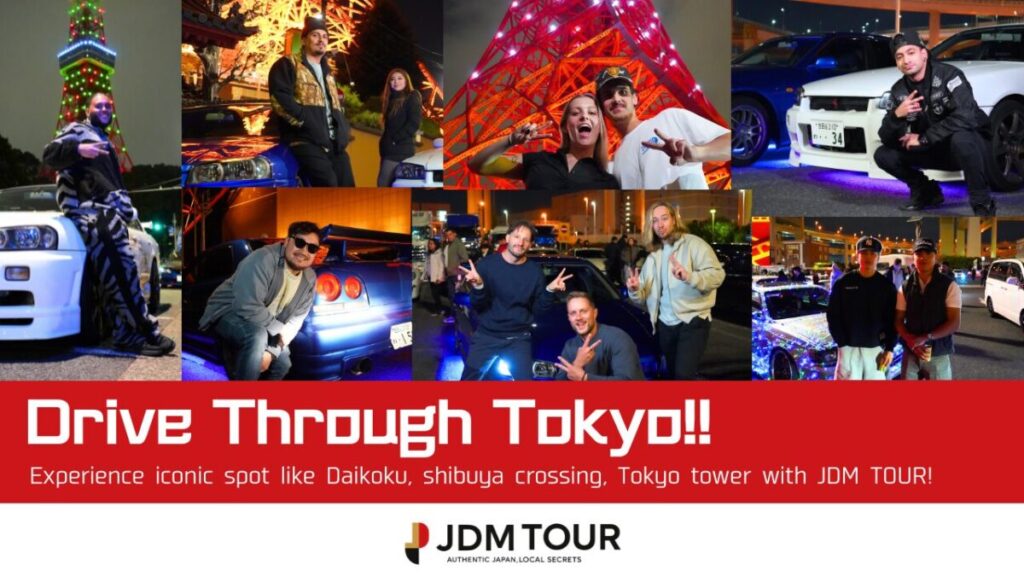
While standard rentals are practical, a new trend has exploded among car enthusiasts visiting Japan: renting “JDM” (Japanese Domestic Market) cars through specialized services like JDM TOUR.
The New Standard of Japan Travel: Public Roads in the Movie
The experience of being able to rent sports car japan is no longer just about driving; it has evolved into an "attraction" that transforms Japan's public roads into a real-life game world. In recent years, an exploding trend among international travelers is enjoying the act of driving through Japanese cities itself as a form of entertainment.
Specifically, commanding JDM machines such as the Nissan GT-R or Toyota Supra against the backdrop of Tokyo’s iconic landmarks is no longer just transportation; it is positioned as a participatory "activity." Just as cosplay driving tours have emerged, this integrated experience of car and city overturns conventional tourism, offering unforgettable, highly shareable memories that light up social media feeds.
This new style of journey, facilitated by exotic car rental tokyo services, has transformed from merely pursuing speed into a means of experiencing unforgettable "play." It allows you to deeply engage with Japan's unique culture and landscapes, creating an adventure that goes beyond traditional sightseeing.
Why is JDM So Popular Right Now?
Legendary sports cars manufactured in Japan during the 1990s and early 2000s—such as the Nissan Skyline (R34), icons for fans worldwide. For many, driving these cars on the actual roads they were designed for is a bucket-list experience that surpasses any standard sightseeing tour.
The Unique Charm of a JDM TOUR
JDM TOUR offers more than just a “car rental”; it provides a deep dive into Japanese car culture.
- The Pilgrimage to Daikoku PA: The highlight of many tours is driving to the Daikoku Parking Area on the Shuto Expressway. At night, this spot transforms into a gathering place for hundreds of beautifully customized cars, creating a vibrant atmosphere that is world-famous.
- Professional Guided Convoys: Driving a right-hand-drive manual car through the complex Shuto Expressway can be daunting. JDM TOUR offers plans where a professional guide leads the way in a lead car, ensuring you stay on the right path safely.
- Photography and Content Creation: The guides know the best “insta-worthy” spots, such as the Shibuya Crossing, Tokyo Tower, and Rainbow Bridge, allowing you to capture professional-quality memories with your dream car.
Location for JDM TOUR
Where Should You Drive? The Area You Choose Changes Everything
You can rent the exact same car and still have a completely different experience depending on where you drive it.
Hakone and the Mt. Fuji area are a natural fit for JDM driving
Hakone and the Fuji area are popular for a reason. They are relatively accessible from Tokyo and offer a mix of beautiful scenery and rewarding roads. Fun2Drive has built its entire concept around this region and the type of driving experience it offers.
For visitors who do not know the area, guided-tour formats have a lot of value. You are less likely to get lost, you can spend more time on the roads worth driving, and you get a smoother entry into Japanese road manners and local conditions.
If you stay only in central Tokyo, the driving may be less satisfying than expected
Renting in the Tokyo area is convenient, but if you try to enjoy a JDM car only within the city, the result can be more frustrating than exciting. Congestion, traffic lights, parking costs, and heavy traffic all get in the way. For first-time visitors adapting to right-hand drive and left-side traffic, it is usually better to plan the drive around escaping the dense city environment as early as possible.
Beginners should prioritize roads that are enjoyable and safe, not just photogenic
On social media, JDM cars paired with mountain roads, scenic viewpoints, and night views look incredible. In reality, those same areas may involve narrow lanes, oncoming traffic, sightseeing buses, steep gradients, and parking restrictions. Choosing a route based only on how it looks online can backfire badly.
One of the best ways to improve satisfaction with rental JDM car in Japan is to avoid overloading the schedule. A half-day works better for nearby driving, a full day fits Hakone or Fuji, and a multi-day plan may justify expressway passes and broader touring. Matching the car and the route to the time you actually have is one of the biggest keys to success.
A Booking Flow That Reduces the Risk of Failure
People who succeed with rental JDM car in Japan do not book impulsively. They check the right things in the right order.
Filter by eligibility before you filter by dream car
Your first step should be checking age, license history, manual eligibility, IDP or translation requirements, and payment conditions. If you eliminate the options you cannot legally or practically book, the rest of the process becomes much smoother. Specialist operators such as Omoren make this easier by listing age, license-duration, and manual requirements clearly in their FAQ.
Then go after dates with real stock availability
Popular JDM cars, especially manuals and rarer models, disappear quickly during travel peaks and weekends. Even at major rental brands, sports models may be available only at certain stores. Orix’s GR86-related promotions, for example, were clearly tied to limited periods and locations.
Because of that, many travelers have better results when they keep the travel schedule slightly flexible around the car, rather than locking flights and hotels first and trying to fit the car in afterward.
Think about pickup and return logistics before you confirm
Whether you rent in Tokyo and drive out to Hakone, or pick up closer to your driving destination, changes the experience a lot. Escaping central Tokyo traffic can take time, so if you only have a short rental period, pickup location matters more than people think. On the other hand, services near Hakone put you closer to the best roads but require you to plan your access there in advance. Fun2Drive highlights its proximity to the Hakone region within about two hours of Tokyo.
Check accident and breakdown support too
With a JDM rental, the process does not end once the keys are in your hand. You should also know whether the company offers English support, what roadside assistance is available, whether a police report is required after an incident, and how much the NOC may be. Large operators often explain these systems more clearly, and Toyota Rent a Car provides relatively straightforward guidance on coverage and liability.
How to Maximize Satisfaction With Rental JDM Car in Japan
Finally, here are the ideas that most strongly affect whether the experience actually feels worth it.
Choose the best car for you now, not the “strongest” car on paper
It is easy to choose based on reputation alone, but some famous cars can be tiring if they are too large, too demanding, or too stressful in real traffic. For a first JDM rental in Japan, a GR86 or Roadster-type car may be the smarter choice. More experienced drivers may feel comfortable stepping up to something like a GT-R or RX-7.
Pick the right time of day
Early morning often offers lighter traffic, cleaner scenery, and a better chance to actually enjoy the car. By contrast, evenings around sightseeing areas or dense city zones tend to reduce satisfaction through congestion and parking stress. Especially with short rentals, time of day can matter as much as the route itself.
The right mindset is not “attack the road,” but “experience the car”
People who love JDM culture often imagine something much more aggressive than what public-road driving in Japan really is. But the value of the experience comes from the engine feel, gear changes, steering response, scenery, and the atmosphere carried by the car itself. The people most satisfied with rental JDM car in Japan are usually the ones who do not overdrive the experience.
Conclusion
Rental JDM car in Japan can be an outstanding experience if you prepare properly. Japan really does have services offering cars such as the GT-R, Supra, RX-7, AE86, GR86, and Fairlady Z, and you can choose between large rental chains and specialist enthusiast operators.
But the real difference between a great experience and a disappointing one is not how much you know about the cars. It is whether you understand license requirements, age and driving-history rules, insurance terms, route selection, and realistic scheduling. For foreign travelers especially, confirming the validity of your IDP or translation should come before everything else.
Renting the car itself is not the hard part. The hard part is putting yourself in a position to enjoy it properly. If you get that part right, driving a JDM car in Japan can become one of the most memorable parts of the trip.