Why This Experience Stands Out
Many people searching for a cinematic jdm car tour tokyo are not simply looking to ride in a cool car. What they really want is not transportation, but an experience that feels like a scene from a movie: Tokyo’s expressways at night, the lights of the bay area, the Rainbow Bridge, Daikoku PA, Tokyo Tower, and the presence of an iconic JDM machine all blending into one unforgettable moment.
That is exactly why this kind of tour stands out from ordinary sightseeing. In Tokyo, JDM-themed experiences often combine famous urban views with the atmosphere of Japanese car culture. Instead of just visiting landmarks on foot, you move through the city as part of the scenery itself. The appeal is not only what you see, but how you see it—from inside a Skyline, GT-R, Supra, RX-7, Silvia, or another car that many enthusiasts have admired for years.
At the same time, this is also a category where people can end up disappointed if they book based only on flashy photos or social media clips. Whether you drive the car yourself or ride as a passenger changes the entire experience. Daikoku PA is not a place you can casually walk into, weekend access conditions can change, and there is never a guarantee that you will see a huge lineup of legendary cars on a given night. That does not make the experience worse, but it does mean expectations matter.
In this guide, you will learn who a cinematic JDM car tour in Tokyo is best suited for, what to check before booking, which routes and highlights create that “cinematic” feeling, and how to choose the right format without making expensive mistakes. If this is your first JDM experience in Tokyo, this article should help you understand which style fits you best.
What Is a Cinematic JDM Car Tour Tokyo Experience?
The first thing to understand is that cinematic jdm car tour tokyo is not just a catchy travel phrase. It describes a very specific kind of experience. In this context, “cinematic” usually means something atmospheric and visually dramatic—an experience where the route, the city lights, the car itself, and the feeling of movement come together in a way that feels almost scripted, like a scene from a film.
A JDM car tour, meanwhile, refers to an experience built around Japanese performance cars and tuning culture. In Tokyo, that often means combining famous city landmarks with places closely associated with car enthusiasts. The result is something that sits between nightlife, urban sightseeing, and motorsport-inspired culture. It is not about memorizing specs or learning every chassis code. It is about stepping into a world you may have only seen in videos, games, anime, or movies.
What people searching this term usually want is not a technical breakdown of horsepower figures. They want to know: Can I actually feel like I’m part of that world? That feeling often comes from the contrast between different scenes in one continuous drive. You might begin in the neon energy of Shibuya, move toward the Rainbow Bridge and the open glow of the bay, stop at Daikoku PA where car enthusiasts gather, and finish with Tokyo Tower in the background for photos. The emotional appeal comes from how those locations connect.
That is also why Tokyo works especially well for this kind of experience. It offers a rare combination of dense urban visuals, iconic expressway routes, and real-world car culture. For travelers who love Japanese cars, the city gives them a chance to see the setting and the machines together rather than as separate attractions.
Who Is It For, and Who May Not Enjoy It?
This type of experience is ideal for people who have a genuine fascination with JDM cars and Japanese car culture. If names like R34, GT-R, Supra, RX-7, Evo, or Silvia instantly mean something to you, the tour can feel less like normal sightseeing and more like a personal pilgrimage. The appeal is not limited to the car itself either. People who enjoy expressways, parking area culture, tuning scenes, photo opportunities, and the atmosphere around enthusiast gatherings tend to get the most value from it.
It is also a great fit for travelers who do not want a standard Tokyo itinerary. Traditional sightseeing in places like Asakusa, Shinjuku, or Meiji Shrine can be excellent, but a cinematic JDM tour offers a very different side of the city. Instead of walking from one landmark to another, you experience Tokyo through movement, light, sound, and speed. The city becomes a backdrop that keeps changing rather than a series of isolated stops.
This experience can also suit couples, friend groups, and content-focused travelers who care about visual storytelling. If part of your goal is to create memorable photos or videos, or simply to have one “this only happens in Tokyo” night, a well-designed JDM tour can deliver that much better than many conventional activities.
That said, it is not for everyone. If you do not care about cars at all, prefer quiet and predictable sightseeing, or expect a fully controlled show-like experience, you may not enjoy it as much. Daikoku PA is a living car culture spot, not an amusement attraction. The number and type of interesting cars present on any given night can vary a lot. Some people love that unpredictability because it feels authentic. Others may find it frustrating if they expect a guaranteed spectacle.
It may also be a poor fit for travelers who are strongly committed to driving themselves but have little experience with right-hand-drive cars or feel nervous in dense urban traffic. The fantasy of driving an iconic JDM car is powerful, but Tokyo roads and expressways are not the best place to treat that lightly.
The Classic Tokyo Routes and Highlights That Feel Truly Cinematic
What makes a Tokyo JDM tour feel cinematic is not just one location. It is the flow between locations. The emotional effect comes from the way the city changes around you as you move through it. In many popular routes, the journey often connects places such as Shibuya, the Rainbow Bridge, the bay area expressways, Daikoku PA, and Tokyo Tower. That sequence creates a strong visual rhythm: crowded city energy, then open night views, then enthusiast culture, then a final iconic Tokyo image.
Shibuya Scramble Crossing
Shibuya is one of the strongest symbols of modern Tokyo. It represents intensity, movement, crowds, and urban spectacle. Starting near Shibuya or passing through the area gives the experience a dramatic opening. The contrast between packed city streets and the more open rhythm of the expressway later on makes the whole tour feel more layered.
From a cinematic perspective, Shibuya works because it instantly establishes “Tokyo” in a recognizable way. Even if you spend only a short time there, it acts like an opening scene before the tour shifts into the car-focused portion of the night.
Rainbow Bridge and the Tokyo Bay Area
The Rainbow Bridge is one of the key visual transitions in this experience. It connects central Tokyo to the waterfront and the bay area, and at night it gives you a sense of the city opening up. The lights, the water, the larger roads, and the changing skyline create a distinctly different mood from central Tokyo’s dense streets.
This part of the route is one of the main reasons the word “cinematic” feels appropriate. Photos rarely capture the full effect. The feeling of passing through the bridge and bay area while city lights stretch across the horizon is much more immersive in motion than in still images.
Daikoku Parking Area
Daikoku PA is one of the most important places in the Japanese enthusiast imagination. It is not a polished tourist attraction, which is exactly why it matters. For car lovers, it represents a real meeting point where people gather, park, look around, talk, and show up in whatever machine they brought that night.
That authenticity is central to the experience. The atmosphere comes from real engines, real owners, real conversations, and whatever happens to gather there naturally. On one night you may see a broad variety of modified cars. On another, the scene may be quieter or skew toward different styles. The appeal lies in the fact that it feels alive rather than staged.
Tokyo Tower
Tokyo Tower works especially well as a closing visual moment. It gives the tour a strong sense of completion, almost like the final frame of a night drive story. Even for people who are not deeply interested in landmarks, Tokyo Tower offers a backdrop that instantly says “this happened in Tokyo.”
It is also one of the best spots for photos that combine the city, the car, and the traveler in a single composition. If the earlier parts of the route are about movement and mood, Tokyo Tower is often where the experience becomes something you can clearly preserve and take home.
Important Things to Check Before You Book
The most important part of booking a cinematic JDM tour is not how impressive the car looks in the listing. It is whether you clearly understand the participation conditions and operating realities.
The first major point is whether the experience is self-drive or passenger-based. If you are driving, you may need specific documents, age eligibility, minimum driving history, and in many cases an appropriate international driving permit depending on the operator and your country of origin. These requirements are not minor details. If you fail to meet them, you may lose your booking or arrive excited only to find out you cannot participate as planned.
The second important point is Daikoku PA access. Many first-time visitors assume they can simply take a taxi or public transport nearby and enter casually. In reality, it is not that straightforward. Daikoku is effectively a car-based destination in this context. If seeing it is one of your main reasons for booking, you should treat transportation logistics as fundamental rather than optional.
Another thing to remember is that the scene at Daikoku is never guaranteed. Some nights are incredible. Others are more subdued. That does not mean the tour is bad; it means the experience is real. If your expectation is “I must see a huge lineup of dream cars no matter what,” you may be setting yourself up for disappointment. A healthier expectation is that you are going to experience Tokyo’s car culture in its natural form, whatever shape it takes that night.
If you plan to drive, you should also take right-hand-drive reality seriously. For many travelers, the dream of driving a JDM icon is huge, but Tokyo is not a forgiving place to learn basic spatial habits. Lane position, expressway merges, traffic flow, and general unfamiliarity can quickly turn a dream into a stressful experience. If your main goal is atmosphere rather than the act of driving itself, choosing a passenger experience may lead to a much better night.
How to Choose Without Regret | Passenger Tours, Self-Drive Tours, and Private Tours
The easiest way to narrow your options is to decide whether you want a passenger tour or a self-drive tour.
A passenger tour is usually the safest starting point for most travelers. Someone else handles the driving, and you can focus on the route, the skyline, the sounds, and the feeling of the experience. It is often the best choice for first-time visitors, people without confidence in Tokyo driving conditions, and travelers who care more about immersion, photos, and atmosphere than about holding the steering wheel themselves.
A self-drive tour can be incredibly rewarding, but it demands more from you. The dream factor is obvious: driving a famous Japanese sports car through Tokyo or toward Daikoku is something many enthusiasts have imagined for years. However, that dream comes with practical layers—documents, permits, insurance rules, deposits, traffic confidence, and vehicle familiarity. If you are experienced and prepared, it can be unforgettable. If you are not, it can become more stressful than enjoyable.
A private tour sits in another category. It is usually more expensive, but it offers more flexibility and a more personal feel. This can be especially good for couples, close friends, or small groups who want the evening to feel like their own story rather than a shared group activity. Private formats can also make photo stops, pacing, and conversation flow more natural.
The best choice depends on what matters most to you. If your priority is maximum immersion, start with a passenger tour. If your lifelong dream is to drive the car yourself, then a self-drive option may be worth the extra complexity. If your priority is freedom, privacy, and a more tailored atmosphere, a private format is often the strongest fit.
How to Enjoy the Day | Photos, Clothing, and the Best Time
If you want the experience to feel as good in reality as it looks in your imagination, small choices on the day matter more than people expect.
The best time is usually after sunset and into the night. A lot of the cinematic quality comes from artificial light—tower illumination, expressway reflections, bridge lighting, bay views, and the glow of the city against the car. A daytime run can still be enjoyable, but if your goal is that moody Tokyo-at-night feeling, evening is where the experience really comes alive.
For content and memories, it helps to separate your mindset into two kinds of shots. First, there are stopped-photo moments: the car parked with Tokyo Tower, a close angle on the front end, wheels, interior details, or a clean three-quarter shot with the skyline behind it. Second, there are moving-mood moments: clips of lights passing by, reflections inside the cabin, the bridge structure overhead, and the road unfolding ahead. The second category often feels more cinematic than the first, even if it is less polished.
Clothing also matters more than many car enthusiasts expect. If you want your photos to age well, simpler outfits usually work better. Dark neutrals, white, gray, navy, and understated layers tend to fit better with urban night photography and with the car itself. Loud patterns or overly bright statement pieces can draw attention away from the vehicle and the setting.
Perhaps the most important tip, though, is about expectation. The experience becomes richer when you stop treating it like a checklist and start treating it like a night with a strong atmosphere. If you go in expecting a perfectly scripted sequence, you may focus too much on what did not happen. If you go in ready to absorb the mood, the route, the city, and the culture, the night tends to leave a much deeper impression.
[The Hottest Experience] Driving Dream Sports Cars in Japan with JDM TOUR
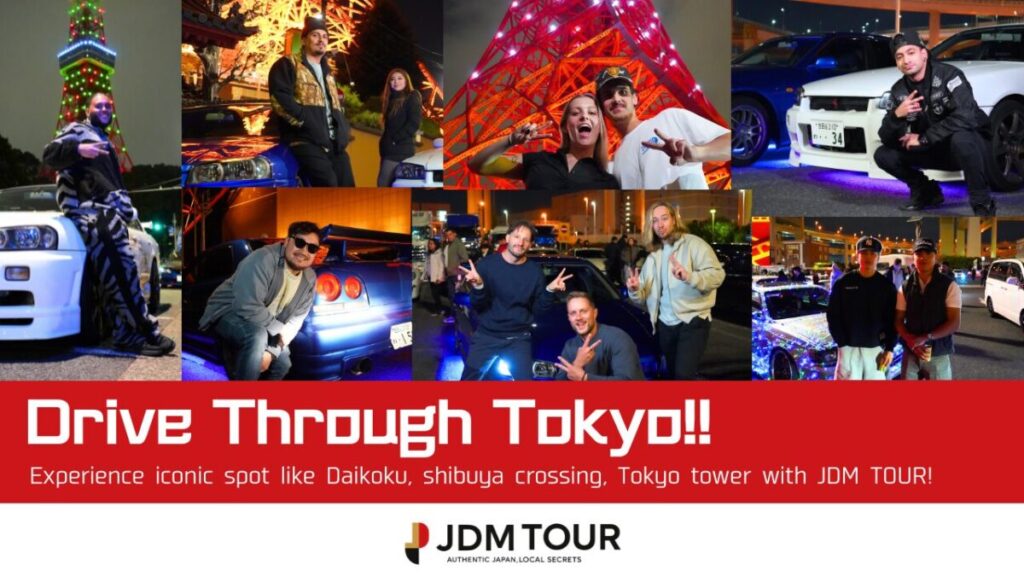
While standard rentals are practical, a new trend has exploded among car enthusiasts visiting Japan: renting “JDM” (Japanese Domestic Market) cars through specialized services like JDM TOUR.
The New Standard of Japan Travel: Public Roads in the Movie
The experience of being able to rent sports car japan is no longer just about driving; it has evolved into an "attraction" that transforms Japan's public roads into a real-life game world. In recent years, an exploding trend among international travelers is enjoying the act of driving through Japanese cities itself as a form of entertainment.
Specifically, commanding JDM machines such as the Nissan GT-R or Toyota Supra against the backdrop of Tokyo’s iconic landmarks is no longer just transportation; it is positioned as a participatory "activity." Just as cosplay driving tours have emerged, this integrated experience of car and city overturns conventional tourism, offering unforgettable, highly shareable memories that light up social media feeds.
This new style of journey, facilitated by exotic car rental tokyo services, has transformed from merely pursuing speed into a means of experiencing unforgettable "play." It allows you to deeply engage with Japan's unique culture and landscapes, creating an adventure that goes beyond traditional sightseeing.
Why is JDM So Popular Right Now?
Legendary sports cars manufactured in Japan during the 1990s and early 2000s—such as the Nissan Skyline (R34), icons for fans worldwide. For many, driving these cars on the actual roads they were designed for is a bucket-list experience that surpasses any standard sightseeing tour.
The Unique Charm of a JDM TOUR
JDM TOUR offers more than just a “car rental”; it provides a deep dive into Japanese car culture.
- The Pilgrimage to Daikoku PA: The highlight of many tours is driving to the Daikoku Parking Area on the Shuto Expressway. At night, this spot transforms into a gathering place for hundreds of beautifully customized cars, creating a vibrant atmosphere that is world-famous.
- Professional Guided Convoys: Driving a right-hand-drive manual car through the complex Shuto Expressway can be daunting. JDM TOUR offers plans where a professional guide leads the way in a lead car, ensuring you stay on the right path safely.
- Photography and Content Creation: The guides know the best “insta-worthy” spots, such as the Shibuya Crossing, Tokyo Tower, and Rainbow Bridge, allowing you to capture professional-quality memories with your dream car.
Location for JDM TOUR
What to Check When Comparing Prices
Price matters, but with a cinematic JDM tour, what is included matters even more. A lower price does not automatically mean better value, and a higher price does not automatically mean a better experience.
Start by looking at whether the listing clearly explains tolls, fuel, insurance, guide services, and any photo support. Two tours with similar durations can feel completely different in value depending on what is built into the package. Sometimes the headline price looks attractive until you realize key items are treated separately.
Another major factor is vehicle assignment. If you have a specific dream car in mind, such as an R34 or a GT-R, do not assume every listing guarantees that exact model. Some tours assign vehicles based on availability or category rather than an exact promise. If the car itself is central to your motivation, check this point before comparing anything else.
You should also pay attention to meeting points and route transparency. A tour that clearly explains where you start, where you are likely to go, and how long major sections take can be much easier to trust than one built mostly around dramatic marketing language.
Finally, remember that the best-value tour is the one that matches your priorities. A cheaper option that gives you the wrong format, the wrong car, or the wrong atmosphere is not actually a better deal.
Answers to Common Concerns
Can I join if I only speak English?
In many cases, yes. Tokyo’s JDM experience market includes many options aimed at international visitors, so English-friendly tours are common. That said, language friendliness is different from legal clarity. If you are choosing a self-drive option, make sure you fully understand the permit rules, insurance conditions, and any eligibility requirements before booking.
Will Daikoku PA always be full of amazing cars?
Not always. That is one of the most important mindset adjustments to make. Some nights will be more exciting than others. The scene depends on timing, conditions, and who happens to show up. That unpredictability is part of what makes the place feel genuine.
Can I enjoy it even if I am not deeply knowledgeable about cars?
Yes. While enthusiasts may get more out of specific models and references, many people enjoy these tours simply for the atmosphere. Tokyo at night, the expressway views, the styling of the cars, and the overall sense of entering a different side of the city can be compelling even without deep technical knowledge.
Is self-drive better for a first experience?
For most people, not necessarily. If this is your first time doing anything like this in Tokyo, a passenger experience is often the better introduction. It allows you to understand the rhythm, route, and atmosphere without the pressure of unfamiliar driving conditions. If you love it, self-drive can become the next step rather than the starting point.
Conclusion
A cinematic jdm car tour tokyo is one of the most distinctive ways to experience Tokyo if you love Japanese cars, urban night views, or the intersection of both. Its appeal comes from more than just the vehicle. The real magic is in how the experience flows—from the energy of Shibuya to the openness of the bay, from the live atmosphere of Daikoku PA to the iconic finish near Tokyo Tower.
At the same time, your satisfaction will depend heavily on choosing the right format and checking practical conditions before booking. Understanding the difference between self-drive and passenger experiences, knowing that Daikoku is not a casual walk-in destination, accepting that the car scene changes from night to night, and being realistic about right-hand-drive confidence can make a huge difference.
If you are planning to book one, the best starting question is simple: Are you chasing the dream of driving, or the feeling of immersion? Once you answer that honestly, it becomes much easier to choose the right tour, the right route, and the right overall experience for your Tokyo trip.