Introduction
When people search for a jdm car experience tokyo, they are usually not just looking for a generic car-related activity. What they really want to know is whether they can experience Tokyo’s JDM culture in a meaningful way, whether they can visit iconic places like Daikoku PA, whether they can drive the car themselves, and whether the experience is actually worth the price.
In practice, this category includes several very different types of experiences. Some are night cruises where you ride along as a passenger. Others let you drive a JDM car yourself with guidance. Some focus more on the broader car culture, including stops at automotive lifestyle spots and well-known tuning-related locations. On top of that, Daikoku PA is not a casual sightseeing destination that you can simply walk into from a nearby street, so access itself is part of the challenge.
That is exactly why booking the right plan matters. If you understand the differences in advance, you are far more likely to choose an experience that matches your expectations instead of ending up with something that feels less immersive than you imagined.
This article reorganizes the topic using the same content as the Japanese version, but in an H3-based structure, while keeping the logic and overall flow intact.
What “JDM Car Experience Tokyo” Really Means
The phrase jdm car experience tokyo generally refers to travel and activity services that let visitors experience Japanese car culture in and around Tokyo. Originally, JDM meant Japanese Domestic Market, referring to cars and parts intended for the Japanese domestic market. Today, however, the term is often used much more broadly to describe Japanese sports cars from the 1980s to early 2000s, as well as the tuning and enthusiast culture built around them.
That means most people searching this keyword are not looking for an ordinary rental car. They are looking for an experience that captures the atmosphere of JDM culture itself. In Tokyo, that often means combining cars with iconic night scenery, elevated expressways, stopovers at well-known locations, and the feeling of being close to the local enthusiast scene.
In practical terms, these experiences can usually be grouped into three categories.
The first is the ride-along type, where you sit in the passenger or rear seat while a guide or driver takes you through the city and toward places such as Daikoku PA.
The second is the self-drive type, where you get behind the wheel of a JDM car yourself and follow a guided route around Tokyo and the bayside expressway area.
The third is the car-culture type, where the focus is not only on driving, but also on lifestyle-oriented locations such as A PIT AUTOBACS SHINONOME, where shopping, browsing, and simply soaking in the atmosphere are part of the appeal.
These categories may sound similar from the outside, but the requirements, the pacing, and the kind of satisfaction they offer are very different.
Why a JDM Experience in Tokyo Feels So Special
Tokyo’s appeal in this space comes from more than just the cars. The city itself acts as part of the experience.
What makes a jdm car experience tokyo stand out is the way urban scenery and car culture overlap. Routes associated with these experiences often include areas such as Shibuya, Roppongi, Tokyo Tower, the Rainbow Bridge, and the bayside expressways. This creates something much more cinematic than simply “looking at a cool car.” It feels like stepping into a version of Tokyo that many enthusiasts have already seen in videos, films, games, and social media.
That is why these experiences resonate so strongly with overseas visitors. They are not only engaging with a car; they are engaging with a very specific image of Tokyo at night. The road itself, the lighting, the skyline, the elevated structures, and the destination all work together to shape the emotional impact.
Another reason Tokyo stands out is that it has real destinations for car enthusiasts beyond the drive itself. Places like A PIT AUTOBACS SHINONOME are not just auto parts stores. They function as lifestyle-oriented automotive spaces, where the culture extends into books, accessories, tuning goods, conversation, and atmosphere. In other words, a Tokyo JDM experience often feels complete because it includes not only motion, but also places where car culture visibly lives.
Which Type of Experience Should You Choose?
The best way to choose a jdm car experience tokyo is not to start with what looks the most popular. It is better to begin by asking what kind of experience you actually want.
If you want to combine JDM culture with sightseeing and keep things simple, the ride-along format is usually the easiest choice. Because someone else is driving, you can focus on the city lights, the sound of the car, conversation with the guide, and taking photos or videos. This style works especially well for travelers who want a memorable Tokyo night without the stress of navigating unfamiliar roads.
If your priority is actually driving a JDM car yourself, then the self-drive option is far more satisfying. This type is better suited to people who care deeply about the act of driving rather than only the surrounding scenery. That said, this is also where expectations need to be realistic. Tokyo’s expressway network is not a relaxed scenic route. It is real urban infrastructure, with merges, lane changes, traffic flow, and fast-moving road decisions. A guided or lead-car format makes a huge difference here.
If you are more interested in the broader automotive scene, a culture-focused plan may be the best fit. Some travelers are happiest when they can browse stores, see products, take in the atmosphere, and feel connected to how car enthusiasm exists in everyday Japanese life. For them, the drive alone is not enough; the destination matters too.
The key is to know which of these matters most to you: driving, nightlife, photography, Daikoku PA, or automotive culture as a whole. The more clearly you define that priority, the easier it becomes to book the right experience.
[The Hottest Experience] Driving Dream Sports Cars in Japan with JDM TOUR
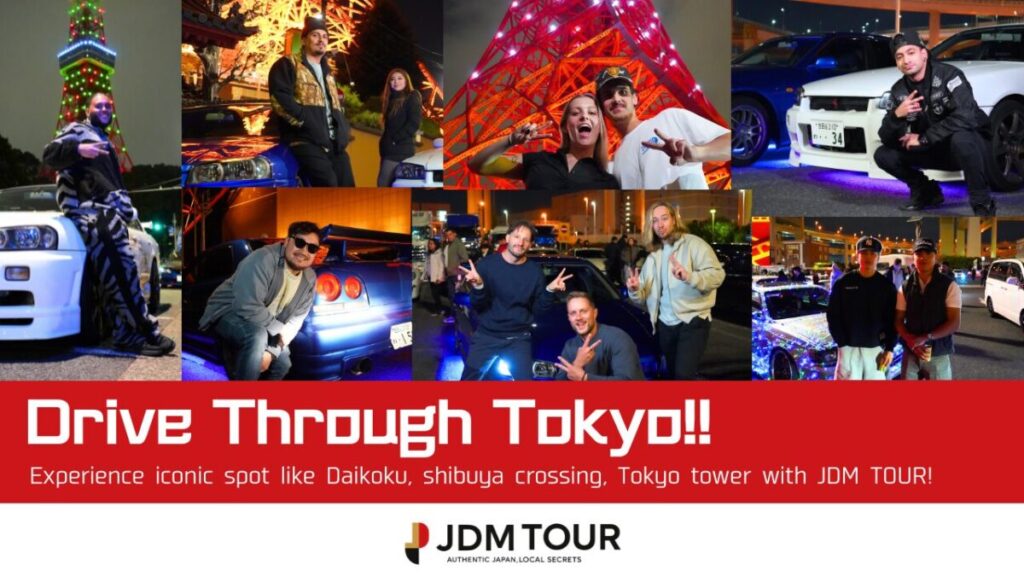
While standard rentals are practical, a new trend has exploded among car enthusiasts visiting Japan: renting “JDM” (Japanese Domestic Market) cars through specialized services like JDM TOUR.
The New Standard of Japan Travel: Public Roads in the Movie
The experience of being able to rent sports car japan is no longer just about driving; it has evolved into an "attraction" that transforms Japan's public roads into a real-life game world. In recent years, an exploding trend among international travelers is enjoying the act of driving through Japanese cities itself as a form of entertainment.
Specifically, commanding JDM machines such as the Nissan GT-R or Toyota Supra against the backdrop of Tokyo’s iconic landmarks is no longer just transportation; it is positioned as a participatory "activity." Just as cosplay driving tours have emerged, this integrated experience of car and city overturns conventional tourism, offering unforgettable, highly shareable memories that light up social media feeds.
This new style of journey, facilitated by exotic car rental tokyo services, has transformed from merely pursuing speed into a means of experiencing unforgettable "play." It allows you to deeply engage with Japan's unique culture and landscapes, creating an adventure that goes beyond traditional sightseeing.
Why is JDM So Popular Right Now?
Legendary sports cars manufactured in Japan during the 1990s and early 2000s—such as the Nissan Skyline (R34), icons for fans worldwide. For many, driving these cars on the actual roads they were designed for is a bucket-list experience that surpasses any standard sightseeing tour.
The Unique Charm of a JDM TOUR
JDM TOUR offers more than just a “car rental”; it provides a deep dive into Japanese car culture.
- The Pilgrimage to Daikoku PA: The highlight of many tours is driving to the Daikoku Parking Area on the Shuto Expressway. At night, this spot transforms into a gathering place for hundreds of beautifully customized cars, creating a vibrant atmosphere that is world-famous.
- Professional Guided Convoys: Driving a right-hand-drive manual car through the complex Shuto Expressway can be daunting. JDM TOUR offers plans where a professional guide leads the way in a lead car, ensuring you stay on the right path safely.
- Photography and Content Creation: The guides know the best “insta-worthy” spots, such as the Shibuya Crossing, Tokyo Tower, and Rainbow Bridge, allowing you to capture professional-quality memories with your dream car.
Location for JDM TOUR
What You Should Know About Daikoku PA Before You Go
For many people, the symbolic centerpiece of a jdm car experience tokyo is Daikoku PA. It has become one of the most recognizable locations associated with Japanese car culture, especially among overseas fans.
Officially, Daikoku PA is a parking area inside the Shuto Expressway system, located within the Daikoku Junction area where the Kanagawa Route and the Bayshore Route connect. It is one of the most prominent parking areas on the expressway network, which helps explain why it carries such a strong reputation.
However, this is also the part that many first-time visitors misunderstand. Daikoku PA is not a regular tourist attraction that you can casually enter on foot. Pedestrians, bicycles, and small motorbikes are not allowed in, and you cannot access it directly from ordinary surface roads. There is also no taxi stand inside. Even if a map app appears to lead you close to it, that does not mean you can simply walk in.
This matters a lot. Daikoku PA is a location that assumes you are arriving through the expressway system. If you make a wrong turn or exit at the wrong point, getting back can be far less simple than expected. That is one of the reasons tours and guided routes have real value here. They remove the guesswork from one of the most famous but least straightforward automotive destinations in the Tokyo area.
It is also important not to romanticize Daikoku PA too much. Its atmosphere can vary depending on timing, traffic, policing, congestion, and general conditions on the day. It is best approached not as a guaranteed car show, but as a place where you may be able to experience a concentrated part of Japan’s enthusiast culture if the timing works in your favor.
What to Check If You Want to Drive Yourself
A lot of travelers are drawn to the idea of self-driving as the ultimate jdm car experience tokyo, but this is where caution matters most.
First, the legal side is not the same for everyone. Whether you can drive in Japan depends on the country or region that issued your license. In some cases, you need a valid International Driving Permit that complies with the required format and conditions under the Geneva Convention. In other cases, drivers from certain countries or regions may use their home license together with an official Japanese translation instead.
That means you should never assume that having “an international license” automatically makes you eligible to drive in Japan. The details matter, including the issuing country, the permit format, and the time-based conditions attached to your stay.
Second, being legally allowed to drive does not necessarily mean you will actually enjoy the experience. Tokyo’s urban expressways can be intense for visitors. Right-hand-drive cars, dense lane changes, signs, traffic flow, and nighttime driving all combine to raise the difficulty. Even confident drivers may find that what sounded exciting in theory becomes mentally exhausting in practice.
This is why guided self-drive formats or lead-car systems are so valuable. They reduce navigation stress and help turn the act of driving into an experience instead of a constant logistics problem. If you are at all unsure about your confidence level, a ride-along or guided option may deliver a better overall memory than a fully self-driven one.
How to Think About Pricing
Pricing in the jdm car experience tokyo category can vary widely, and simply choosing the cheapest option is often the wrong approach.
In Japanese media coverage of inbound-oriented Tokyo car culture tours, example pricing has included around 45,000 yen per person for a six-person plan and 82,000 yen per person for a two-person plan. That sounds expensive if you think of it as transportation, but it makes more sense once you see the full package: hotel pickup, Tokyo night views, Daikoku PA, English-speaking guidance, and in some cases even meals.
Self-drive plans can create even more variation depending on the vehicle involved. Cars such as GT-Rs, older Skylines, or other iconic models naturally increase the price because of rarity, maintenance cost, and demand. In other words, the price is often tied not just to duration, but to the kind of car, the level of curation, and the exclusivity of the experience.
The better way to evaluate cost is to look at what is actually included. Vehicle type, tour duration, whether the plan is private, whether there is a lead car, whether photography is included, what locations are visited, and what language support is available all affect value.
A JDM experience in Tokyo should not be thought of as basic transport. It is better understood as a package that combines car, route, scenery, culture, timing, and guidance. Once you look at it that way, the price differences become easier to understand.
How to Avoid Booking the Wrong Experience
The biggest mistake people make when booking a jdm car experience tokyo is choosing based on a strong image rather than on practical fit.
Start by deciding what matters most to you. Do you want to drive? Do you want to reach Daikoku PA? Do you want the Tokyo skyline at night? Do you want photos, videos, or a more culture-focused stop at places like A PIT? If you do not define that priority, it becomes very easy to end up with something that sounds exciting but does not actually match your personal goal.
It also helps to look for plans with a clearly understandable route. When an experience makes it easy to picture where you will go and what the flow will be, it is much easier to judge whether it fits your expectations. Ambiguous descriptions often lead to disappointment because the traveler and the operator are imagining different things.
If you are considering self-drive, check both the license requirements and your own realistic comfort level. That second part is just as important as the legal one. A person who is technically allowed to drive may still have a much better time as a passenger if they would otherwise be stressed throughout the route.
The best bookings usually happen when expectations are specific, not vague. The more clearly you know whether you want excitement, comfort, immersion, or control, the better the result tends to be.
Conclusion
A jdm car experience tokyo is compelling because it offers more than a chance to see Japanese cars. At its best, it lets you experience cars, roads, scenery, and atmosphere together in a way that feels distinctly Tokyo.
What makes it memorable is the combination: places like Shibuya, Tokyo Tower, the Rainbow Bridge, the Bayshore Route, Daikoku PA, and automotive lifestyle locations in the eastern Tokyo area all connect into a single night that feels difficult to replicate elsewhere.
At the same time, satisfaction depends heavily on understanding the format before you book. Daikoku PA is not a place you casually walk into from the street, and self-drive plans come with real legal and practical requirements. That is why choosing based on fit is much smarter than choosing based only on hype.
If you want a Tokyo JDM experience that genuinely stays with you, pay attention not just to the car itself, but also to the route, whether guidance is included, what stops are part of the experience, and how much of the broader culture is built into the plan. That is what turns a simple activity into one of the strongest memories of a Tokyo trip.