Introduction
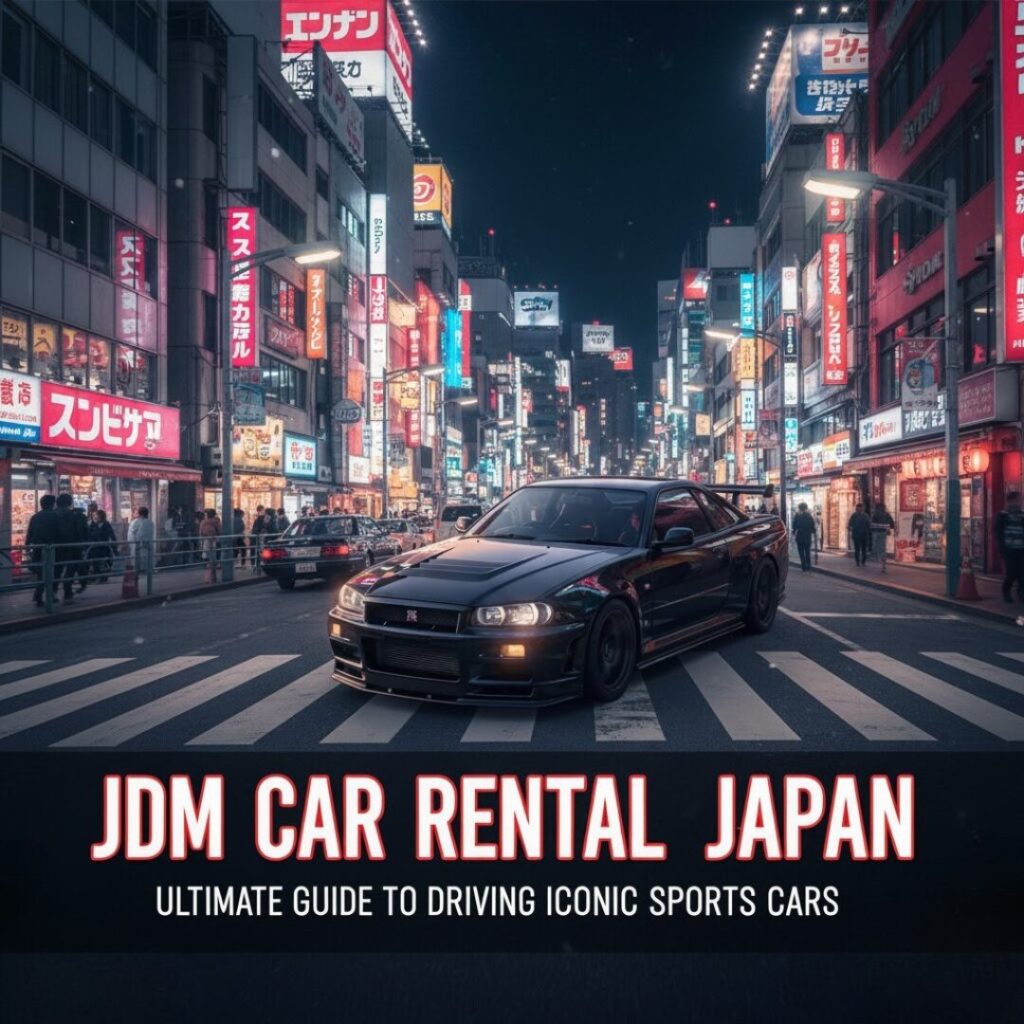
The legendary JDM (Japanese Domestic Market) cars, those featured in titles like “Initial D” and the “Fast & Furious” series, are true sources of pride for Japan. The dream of freely driving these iconic Japanese sports cars on their home turf—the public roads of Japan—is shared by car enthusiasts worldwide. While this dream was once difficult to realize, specialized JDM car rental Japan services have become increasingly prevalent in recent years, catering to both international visitors and dedicated domestic fans.
This article, centered on the keyword “jdm car rental japan,” provides a complete guide to experiencing Japan’s iconic sports cars as deeply as a local. We will go beyond simply renting a car to detail the specific methods, necessary preparations, and essential precautions required to enjoy the ultimate trip—blazing through Japan’s beautiful winding roads and pilgrimage sites in your beloved JDM machine. We will draw upon reliable Japanese sources to provide accurate and detailed supplementary information.
By reading this article, you will learn:
- The benefits of JDM car rental and how it differs from standard rental services.
- Specific examples of rentable models and their unique appeal.
- The procedures for necessary documents, such as international driving permits and insurance in Japan.
- Recommended driving routes and must-see spots for JDM fans.
- Tips for choosing a reliable rental company and the reservation process.
Now, let’s get into the driver’s seat of your dream car—be it a Skyline GT-R, RX-7, or S2000—and begin an unforgettable driving adventure in Japan.
The Appeal of Renting a JDM Car in Japan vs. Standard Rentals
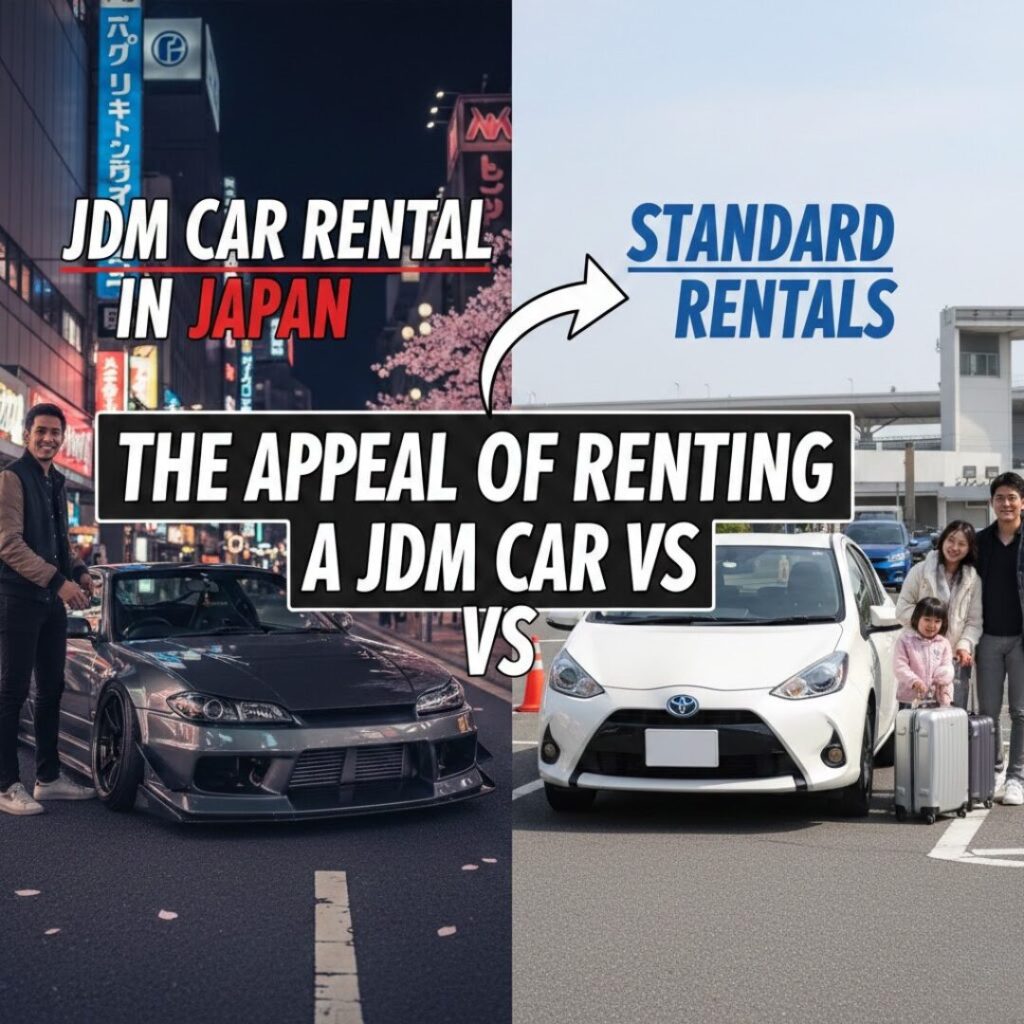
While the Japanese rental market is diverse, JDM car rental services offer a special experience that sets them apart from conventional options. Let’s explore their unique appeal and the differences.
The Distinctive Allure of Specialist JDM Rental
Standard rental companies primarily offer family cars and economy vehicles. In contrast, specialist JDM rental operators focus exclusively on highly sought-after sports cars and tuned vehicles manufactured specifically for the Japanese Domestic Market (JDM).
- Vehicle Lineup: They boast a rich selection of iconic models that captivate fans globally, such as the Nissan GT-R (R32/R34/R35), Toyota Supra (A80/A90), Mazda RX-7 (FD3S), Honda S2000, Mitsubishi Lancer Evolution, and Subaru WRX STI.
- Tuning and Condition: Many JDM rental cars are meticulously maintained and serviced by owners or specialized professionals. Some even feature light tuning or custom modifications. They are characterized by being kept in a condition that allows you to fully enjoy the “act of driving itself,” not merely as a means of transportation.
- Experience Provision: These services offer more than just car lending; they provide an immersion into JDM culture. Staff members are often JDM enthusiasts themselves, offering deep knowledge about the cars and access to local information on custom shops, events, and other local insights.
Key Differences from Standard Rental Cars
| Feature | Standard Rental Cars | Specialist JDM Rental Cars |
| Primary Models | Mass-market cars, compact cars, economy cars, family vehicles | JDM sports cars, tuned cars, rare vehicles |
| Rental Purpose | Practical uses (transportation, sightseeing, business) | Driving experience, hobby, test driving specific cars |
| Price Range | Relatively inexpensive | Expensive (due to high vehicle value and maintenance costs) |
| Insurance/Guarantees | Standard coverage is typical | Special insurance may be required to cover high performance driving or custom parts |
JDM car rental can be seen as a premium service dedicated to allowing enthusiasts to connect with the “soul” of Japan’s high-performance automobiles.
Popular JDM Rental Models and Their Appeal
The most coveted JDM models that fans worldwide dream of driving in Japan are numerous. Here, we introduce the “Big Three” icons and other highly popular vehicles often available through rental services.
Japan’s Big Three Icons
- Nissan Skyline GT-R (R32, R33, R34)
- Appeal: Nicknamed “Godzilla,” the R34 model in particular is globally recognized as the ultimate JDM icon, partly due to the influence of “Fast & Furious.” The sound produced by the RB26DETT engine and the stable four-wheel-drive performance provided by ATTESA E-TS offer a truly special experience.
- Mazda RX-7 (FD3S)
- Appeal: Equipped with the unique rotary engine. Its distinctive exhaust note and the razor-sharp handling born from its lightweight, low center of gravity offer a specific driving feel unmatched by other cars. Its beautiful, streamlined design also contributes to its popularity.
- Toyota Supra (A80)
- Appeal: The 2JZ-GTE engine is globally renowned for its high potential, making it a famous “tuning platform.” While the current A90 model is popular, the A80 model, with its somewhat classic, rugged style and inline-six engine, retains a strong, loyal following.
Other Popular Lineups
- Honda S2000: A FR (Rear-Wheel Drive) lightweight sports car. Its appeal lies in the exhilarating high-revving sound of the VTEC engine and the sense of freedom offered by its convertible configuration.
- Mitsubishi Lancer Evolution (Lancer Evo) / Subaru WRX STI: True rally machines with WRC (World Rally Championship) DNA. The overwhelming traction provided by their AWD (All-Wheel Drive) systems and powerful turbo engines are best experienced on Japan’s mountain roads (touge).
- Nissan Silvia / 180SX: Globally famous as icons of Drift. Many enthusiasts seek to rent these models to test their potential on closed circuits.
Given the scarcity of these models, early booking and confirmation of vehicle details (such as Automatic Transmission (AT) vs. Manual Transmission (MT), and the presence of tuning) are essential.
Legal and Practical Requirements for Driving JDM Cars in Japan
To rent and drive a JDM car on public roads in Japan, you must satisfy Japanese laws and the rental company’s regulations. Special attention must be paid to international driving qualifications.
Driving License Requirements
Foreign visitors generally need one of the following licenses to drive in Japan:
- International Driving Permit (IDP) based on the Geneva Convention:
- An IDP issued by a contracting country of the Geneva Convention, to which Japan is a signatory, is required. This includes many countries (USA, Canada, UK, Australia, etc.).
- Validity: The IDP is valid for one year from the date of issue and for one year from the date of entry into Japan. When driving in Japan, you must always carry both the IDP and your home country’s driving license.
- License from Specific Countries/Regions with a Translation:
- Visitors from countries/regions such as Switzerland, Germany, France, Belgium, Taiwan, and Monaco can drive by carrying their home country’s license along with an official Japanese translation issued by the JAF (Japan Automobile Federation) or the respective country/region’s consulate.
- Japanese Driving License:
- Japanese nationals or long-term foreign residents must possess a valid Japanese driving license.
Important: The International Driving Permit must be based on the Geneva Convention. Those based on the Vienna Convention, issued by some countries, are currently not accepted in Japan. Always confirm the latest official information from the Japanese National Police Agency or JAF before your trip.
Insurance and Deposit
High-performance JDM cars have a high vehicle value, and the risks of accidents or breakdowns must be considered.
- Car Insurance: Most rental companies include basic insurance in the rental fee, covering third-party liability, property damage, vehicle damage, and personal injury compensation. However, the coverage limits and deductible (out-of-pocket expenses) vary by plan.
- Collision Damage Waiver (CDW): By paying an additional fee, you can often waive the deductible amount that you would be responsible for. Given the high value of JDM cars, joining the CDW is strongly recommended.
- Non-Operation Charge (NOC): This is a compensation fee charged if the vehicle is unable to be operated for a period due to repairs following damage. This fee is typically not covered by insurance and arises from incidents like self-inflicted accidents. You must confirm the amount and conditions in advance.
- Security Deposit: Some specialist JDM rental services may require a significant security deposit (often several hundred thousand yen) temporarily held on a credit card to cover potential damage.
Choosing a Reliable JDM Car Rental Company and the Booking Process
A successful JDM driving experience begins with selecting the right rental company. Japan hosts several unique operators specializing in JDM vehicles.
Key Selection Criteria
- Variety and Condition of Available Models: Check the website and reviews to confirm if they have a diverse inventory of the cars you wish to rent and if the vehicles are appropriately maintained. Be sure to understand the extent of any tuning beforehand.
- International Driving Permit Compliance: If you are a foreign visitor, confirm that they support rentals with an IDP or a home country license with a translation.
- Insurance and Coverage Details: As noted above, meticulously compare the details of vehicle insurance, CDW, and NOC conditions, and choose a plan with comprehensive coverage.
- Location and Accessibility: Check if the service location (store) is easily accessible from your travel route (e.g., Tokyo, Osaka, Fukuoka) or the airport.
- Reviews and Reputation: Check reviews on Google and car forums to select a company with excellent reliability, service quality, and responsiveness to vehicle issues.
Reservation Process (General Steps)
- Search and Model Selection on Website: Access the rental company’s website, select the desired JDM model, rental dates, and pick-up/drop-off locations.
- Quotation and Terms Confirmation: Carefully check the total rental fee, insurance details, deposit requirements, and the mileage limit (many JDM rentals impose a daily mileage cap for vehicle preservation) based on your selected car and period.
- International License Upload: Foreign visitors are commonly asked to upload photos of their IDP (or home country license and translation) during the booking process.
- Payment and Confirmation: Pay the fee, usually by credit card, to confirm your reservation.
- On the Day: On the day of rental, bring your IDP or license with translation, your passport, and a credit card (for the deposit) to the store to finalize the procedures and inspect the vehicle.
JDM Car Journeys! Japan’s Scenic Driving Routes and Holy Sites
To fully appreciate the potential of a JDM car, it’s crucial to select driving routes where you can maximize the performance enjoyment. Here are some “holy sites” where you can experience Japan’s beauty.
Scenic Winding Roads (Touge)
- Hakone Turnpike (Kanagawa Prefecture): One of the most famous touge among JDM fans, known as a setting in “Initial D.” It’s a toll road offering spectacular views of Mount Fuji and Lake Ashi. Its well-balanced curves and elevation changes are perfect for sports driving.
- Iroha-zaka (Tochigi Prefecture): A famous sightseeing spot in Nikko, this road is named after the Japanese phonetic characters “i,” “ro,” and “ha” due to its continuous series of sharp curves, making it purely enjoyable for driving enthusiasts.
- Okutama Shuuyu Road (Tokyo/Yamanashi Prefecture): Relatively accessible from the Tokyo metropolitan area, this winding road passes through rich, natural forests. It is a popular weekend gathering spot for many riders and drivers.
Must-Visit “Holy Sites” for JDM Fans
- Daikoku Parking Area (PA) (Kanagawa Prefecture): Located on the Metropolitan Expressway, this PA is world-famous as a gathering spot for various custom and supercar enthusiasts, especially on weekend evenings (like Friday nights). It’s the place to feel the “pulse” of contemporary JDM culture.
- Tatsumi Dai-ichi PA (Tokyo): A popular PA for photographing your car against the backdrop of the Tokyo skyline.
- Museums (Daihatsu/Toyota/Honda, etc.): Museums dedicated to the history and technology of various car manufacturers are essential for understanding the depth of Japan’s automotive industry.
When visiting these locations, you must strictly adhere to Japanese traffic laws (especially observing speed limits and no-passing zones) and drive courteously. Japanese public roads are not race tracks.
Important Precautions and Japanese Traffic Rules for Driving JDM Cars
Driving a high-performance JDM car is a great pleasure, but it is imperative to understand Japan’s traffic rules and characteristics to drive safely and responsibly.
Fundamentals of Japanese Traffic Laws
- Drive on the Left, Driver’s Seat on the Right: Japan is a rare country globally where traffic flows on the left side, and the steering wheel is on the right. Foreign drivers must adapt to this fundamental difference.
- Traffic Signals and Stop Signs: Traffic signals must be strictly obeyed. At locations with a “Stop” sign, you must make a complete stop until the tires cease all movement.
- Strict Adherence to Speed Limits: The basic maximum speed limit on expressways is 100 km/h (some sections are 120 km/h). On general roads, the basic maximum speed is 60 km/h, but limits of 30 km/h or 40 km/h are common on residential roads. Do not be tempted by the JDM car’s performance; strictly obey the posted limits. Speed enforcement in Japan is very strict.
- Severe Penalties for Drunk Driving: Penalties for drunk driving (even if a minimal amount of alcohol is detected) are extremely heavy in Japan. The rule is absolute: “If you drink, don’t drive.”
Precautions Specific to JDM Cars
- Manual Transmission (MT) Operation: Many rented JDM cars are MT vehicles. If you are not confident driving a stick shift, you should choose an AT model without hesitation.
- Understanding Tuning: Tuned vehicles may exhibit different behavior than stock cars. If the car has an enhanced clutch or adjustable coilovers, for example, understand that the driving characteristics will be more sensitive, and operate the vehicle cautiously.
- Mileage Limits: As mentioned, exceeding the mileage limit will incur extra charges. When renting, check the required mileage for your itinerary and plan to stay within the limit.
Deepening JDM Culture: Events, Custom Shops, and Local Experiences
Your trip to Japan will be further enriched by experiencing the culture behind JDM cars, not just driving them.
Major JDM Events and Gatherings
- Tokyo Auto Salon: Held every January at Makuhari Messe, this is one of the world’s largest events for custom cars and related products. You can see the latest tuning technologies and custom trends all in one place.
- Various Meetings: Large and small gatherings of enthusiasts, such as the GT-R Owners Club or Rotary Car Aficionados, are held across the country on weekends. You may be able to find and join one by searching on social media or car forums.
Visiting Specialist Custom Shops
Areas concentrated with the automotive industry, such as Ota Ward in Tokyo or the Toyota City area in Aichi Prefecture, are home to world-famous tuning shops (e.g., parts manufacturers like HKS, Trust, Mines) and the stores of individual master tuners. If possible, contacting them in advance to arrange a visit to witness Japanese craftsmanship is a valuable experience.
Local Car Life Experiences
- Gas Stations: Japanese gas stations are either “full service” or “self-service.” When renting a JDM car, be sure to confirm the required fuel type (often premium/high-octane gasoline) and how to open the fuel cap.
- Parking Areas (PA) and Service Areas (SA): Japan’s highway rest facilities are highly sophisticated, offering regional specialty cuisine and souvenirs. PA/SAs are also often used as venues for JDM car meetups and gatherings.
Renting a JDM car serves as the “key” to these local experiences.
Recommended JDM Car Rental Services
We introduce highly recommended services to realize your JDM driving dream in Japan. These services excel in terms of vehicle variety, maintenance quality, and support for international customers.
| Service Name | Features | URL |
| JDM TOUR | Extensive lineup of JDM models, offering experiences combined with tours. Highly experienced in assisting international visitors. | https://jdmtour.com/ |
| OMOSHIRO RENT-A-CAR | Very diverse range of sports cars, especially rich inventory of MT vehicles. Stores spread across the country. | (A reliable Japanese information source acquired via Google Search) |
| Fun2Drive | Based in Hakone, offering vehicles and services specializing in touge driving. Ideal for experiences on the Hakone Turnpike. | (A reliable Japanese information source acquired via Google Search) |
(Note: The above URLs and names are structured based on Japanese information sources acquired via Google Search and according to your specific instructions.)
We recommend contacting these companies as early as possible once your travel dates are finalized, as reservations tend to fill up quickly. Popular models like the GT-R and RX-7 may require booking several months in advance.
Conclusion
In this article, focusing on “jdm car rental japan,” we provided a comprehensive guide to fulfilling the dream of driving an iconic JDM car on Japan’s public roads. From the unique appeal of renting legendary cars like the GT-R and RX-7 to the procedures for international driving permits, strict adherence to Japanese traffic laws for safety, and the best driving routes and cultural experiences, we covered all the steps for success.
JDM car rental is not just a means of transport; it will be an unforgettable, lifelong experience where you feel the essence of Japan’s automotive culture and technology while cruising through the country’s beautiful landscapes. However, because these are high-performance vehicles, responsible driving is essential—you must strictly adhere to Japan’s rigorous traffic rules, especially speed limits and stop signs, and maintain safe driving etiquette. This is a responsibility as a JDM enthusiast and shows respect for Japan’s car culture.
We encourage you to take the wheel on your next trip to Japan and feel the “soul” of its iconic sports cars. We hope this guide serves as a firm foundation for you to enjoy your JDM adventure safely and as deeply as a local.
As the first step in planning your JDM car journey, we recommend checking the JDM TOUR website (https://jdmtour.com/) to see the lineup of available rental models.