
Introduction
If you want to rent a JDM car in Japan and actually drive it, you have probably already realized that the process is not as simple as booking a normal rental car.
Questions come up quickly: Can you really rent a GT-R or RX-7? Is Tokyo better than Hakone? Is an international driving permit enough? How much should you budget? What documents do you need before booking?
The good news is that JDM-focused sports car rentals do exist in Japan, and in some areas the options are better than many people expect. Around Tokyo and Hakone in particular, you can find services that offer models such as the GT-R, Supra, RX-7, Lancer Evolution, and Civic Type R. At the same time, these are not ordinary rental cars. Compared with standard economy-car rentals, age limits, driving-history requirements, insurance conditions, pickup hours, and license checks tend to be much stricter.
This article is for people searching for jdm cars for rental and wanting a practical, realistic overview of what to expect in Japan. Rather than only listing dream cars, it explains the full picture: popular models, price ranges, area-by-area differences, license rules for international visitors, and the points that often get overlooked before booking. By the end, you should be able to judge not only whether you can rent one, but also which car and which rental style actually fit your trip.
Are JDM cars for rental really available in Japan?
The first thing to understand is that JDM rentals are usually found through specialist providers, not mainstream rental-car chains.
Large rental companies in Japan mainly focus on practical travel cars, compact vehicles, hybrids, and family transport. If you want an R34, R35 GT-R, A80 Supra, RX-7, Evo, WRX STI, or Civic Type R, you will usually need to look at sports-car specialists, JDM-focused operators, or experience-based rental services instead.
That distinction matters because it changes how you should search.
Instead of treating this like a normal car-rental booking, it makes more sense to think in terms of driving experience, car culture, sightseeing routes, and enthusiast demand. Some providers are better for airport-friendly access and city driving near Tokyo, while others are stronger if your goal is to enjoy winding roads in Hakone or the Mt. Fuji area.
How JDM rentals differ from ordinary car rentals
A JDM rental is not just transportation.
For most customers, the purpose is closer to driving a dream car, creating travel memories, taking photos, visiting famous car spots, or enjoying a specific route. Because of that, the conditions are often more restrictive than those of a normal rental car.
Common differences include:
- Higher minimum age requirements
- Preference for drivers with manual-transmission experience
- Fixed pickup and return times
- Extra fees for late-night or out-of-hours returns
- More detailed insurance and liability terms
In other words, you are not simply paying for mobility. You are paying for access to a desirable, sometimes rare, enthusiast vehicle.
Why JDM rentals are so popular now
The rise in popularity is closely tied to the global spread of JDM culture.
Movies, video games, YouTube channels, car media, and social media have all helped turn Japanese performance cars into icons. For many overseas visitors, driving a Japanese sports car in Japan itself has become part of the travel dream.
That is why many of these specialist services now promote multilingual support, international-license guidance, or routes connected to famous enthusiast locations. The experience is often sold not as simple transportation, but as a major highlight of a Japan trip.
Who this kind of rental suits best
JDM rentals are especially well suited to people who:
- Have always wanted to drive a GT-R, RX-7, Supra, or other iconic Japanese sports car
- Care more about the driving experience itself than about getting from A to B cheaply
- Want to feel the personality of a specific car, engine type, or drivetrain
- Plan to combine the rental with destinations such as Daikoku PA, Hakone, or Fuji-area roads
On the other hand, if your priority is simply low-cost transport, a JDM rental is usually not the right fit. Prices, requirements, and expectations are completely different from standard economy-car rentals.
Popular JDM models you can rent and what makes each one appealing
When people search for jdm cars for rental, the first question is usually simple: What can I actually rent?
The answer depends on timing and inventory, but the most common rental candidates are usually well-known Japanese performance models from Nissan, Toyota, Mazda, Honda, Mitsubishi, and Subaru.
Typical examples include:
- GT-R / Skyline GT-R
- Supra
- RX-7
- NSX
- Civic Type R
- Lancer Evolution
- WRX STI
- AE86
Not every provider has every car at all times, but these are the kinds of models that define the category.
GT-R and Skyline GT-R models
The most famous option is usually the GT-R family.
The R32, R33, and especially the R34 Skyline GT-R have legendary status in JDM culture, while the R35 GT-R offers a more modern high-performance experience.
These cars appeal strongly to travelers who want the most iconic badge possible.
If your dream has always been to say “I drove a GT-R in Japan,” this is the category that delivers that feeling immediately.
That said, GT-R rentals often come with stricter conditions.
Because they are powerful, expensive, and highly desirable, age limits and driving-history requirements tend to be more demanding. They are not always the easiest first choice for someone who is new to Japan, new to left-side driving, or new to high-performance rentals.
Supra and Fairlady Z
The Supra is one of the most balanced choices in the JDM rental world.
It has strong enthusiast appeal, a famous name, and a more approachable image than some of the highest-end halo cars. The A80 Supra in particular carries huge emotional value for fans of 1990s Japanese performance cars, while newer GR Supra options may also be available depending on the provider.
The Fairlady Z fills a similar role.
It offers sports-car identity, recognizable Japanese heritage, and a style that works well for both scenic drives and enthusiast trips. If you want something memorable without jumping directly to the most intimidating or highest-priced category, these cars often make a lot of sense.
RX-7, NSX, and lightweight sports icons
The RX-7 is special because of its rotary engine and the unique character that comes with it.
Among JDM fans, it is not just another fast car. It represents a very specific kind of Japanese sports-car engineering, which is why it remains one of the most desirable cars to drive in Japan.
Cars such as the NSX or AE86 appeal for slightly different reasons.
They are not only about power. They are about lightness, handling feel, feedback, sound, and driver involvement. If your idea of a perfect rental experience is a road where the car feels alive beneath you, these models can be even more rewarding than something objectively faster.
Civic Type R, Evo, and WRX STI
If you like high-performance turbo cars and classic tuner-era energy, the Civic Type R, Lancer Evolution, and WRX STI are excellent options.
They carry unmistakable JDM identity while often sitting in a more realistic price band than top-tier GT-R or NSX rentals.
For many people, this group represents the sweet spot between performance, cost, and approachability.
Depending on the exact vehicle, some may also be less intimidating as a first JDM rental, especially if you want something exciting but not overwhelming. Just make sure you confirm whether the car is manual or automatic, because that detail can change the whole experience.
How much does it cost? Understanding the price range
One of the biggest surprises with JDM rentals is that the price structure is completely different from normal car rentals.
Even if you are used to renting cars while traveling, you should think of this as a specialist enthusiast product, not a standard travel expense.
Broadly speaking, prices tend to fall into three rough tiers.
Entry-to-mid enthusiast range
Cars like some Evo, WRX STI, Type R, or older sports models often sit in the more accessible part of the market.
These are still not cheap in the way a normal rental car is cheap, but they can sometimes offer a more realistic first step into the JDM experience.
This category is often attractive for travelers who want something unmistakably Japanese and performance-oriented, but do not need the most famous halo car.
Mid-to-high tier
Cars such as the Supra or RX-7 often move into the next pricing bracket.
This is where emotional value, rarity, and enthusiast demand become more obvious in the price. These cars are popular enough that they often feel like a “dream but still somewhat attainable” option.
If you are choosing between a cheaper but less iconic car and something like an RX-7 or Supra, this is often where you need to decide how much the specific model matters to your overall trip satisfaction.
Premium tier
At the top end, you will typically find cars such as the R34 GT-R, R35 GT-R, and NSX.
These are the headline cars, and the price usually reflects that. In many cases, they are significantly more expensive than lower-tier sports models because of rarity, prestige, insurance risk, and sheer demand.
The key point is that the badge alone does not tell the whole story.
Even within the same model line, the rental price can change based on:
- Year and specification
- Manual vs automatic transmission
- Included rental time
- Insurance coverage
- Mileage conditions
- Season and demand
- Pickup location and operating style
Costs beyond the headline rental price
A common mistake is to focus only on the posted car price.
In reality, your total cost may also include:
- Insurance or liability reduction plans
- ETC card rental
- Extension fees
- Late-return fees
- Additional-driver registration
- Cleaning or penalty terms
- Fuel charges depending on policy
Because of this, the cheapest-looking listing is not always the best value.
A more expensive rental with clearer insurance, easier pickup, better communication, and a better route match may lead to a far better overall experience.
Why price alone is a poor way to choose
With JDM rentals, value is not just about cost.
It is about whether the car, the area, the route, and the rental conditions fit your actual trip. A lower price is not especially useful if the provider is hard to reach, your documents are unclear, or the car does not suit the roads you want to drive.
For international visitors especially, convenience matters more than people often expect.
Airport access, English support, clear document guidance, and realistic return procedures can have a huge impact on whether the experience feels smooth or stressful.
The rental requirements you need to check before anything else
One of the biggest mistakes people make is choosing the car first and checking the requirements later.
With JDM rentals, it should be the other way around. The car may be available, but if you do not meet the provider’s conditions, that availability does not matter.
Minimum age and driving history
Specialist operators often apply higher age limits and longer driving-history requirements than standard rental companies.
That is especially common for more expensive or more powerful cars.
In practical terms, that means you may find conditions such as:
- Minimum age in the mid-20s or above
- A required number of years holding a full license
- Stricter criteria for flagship models like GT-Rs or rare classics
If you are planning around a specific dream car, check these conditions before building the rest of your travel plan around it.
Manual or automatic transmission
A lot of JDM enthusiasts naturally want a manual.
But wanting a manual and being able to enjoy it in Japan are not always the same thing.
Japan means:
- Left-side traffic
- Unfamiliar road signs for many visitors
- Tight city streets in some areas
- Complex expressway merges, especially around Tokyo
- Additional mental load if it is your first time driving in the country
Because of that, some travelers are actually happier choosing an automatic sports car for their first rental in Japan. You may enjoy the trip more if you are not using half your focus on simply managing the transmission in an unfamiliar road environment.
Insurance and liability coverage
This is one of the most important areas to read carefully.
JDM cars, especially rare or older performance models, can be expensive to repair. Parts availability and bodywork costs may also be more difficult than with ordinary cars.
Do not assume the insurance situation is the same from one provider to another.
Check:
- What is included in the base rate
- Whether there is a deductible
- Whether there is an NOC or equivalent non-operation charge
- What exclusions apply
- What happens in the case of wheel, tire, clutch, underbody, or track-related damage
- Whether international drivers face any extra conditions
Pickup times and return procedures
Many specialist providers do not operate like 24/7 airport chains.
Pickup windows may be fixed, return hours may be narrow, and out-of-hours returns may trigger extra fees.
That matters more than it seems.
If you are arriving on a flight, changing hotels, or connecting to another region, timing can affect your experience almost as much as the car itself. A dream rental becomes a hassle very quickly if the logistics do not line up with your itinerary.
What international visitors need to know about licenses and documents
For overseas visitors, this is the most important part of the whole process.
You cannot safely assume that having a foreign driver’s license is enough.
When an international driving permit works
Japan accepts the paper-booklet-style International Driving Permit based on the 1949 Geneva Convention.
That detail matters because not every international license format used around the world is valid in Japan.
In practice, this means:
- A digital display is not enough
- A copy is not enough
- The original document is needed
- You also need to carry your valid home-country driver’s license
This is one of the most common points of confusion for visitors.
When a Japanese translation is required instead
For some countries and regions, the valid route is not an IDP but rather the original license plus an official Japanese translation.
That applies to certain jurisdictions such as Germany, Switzerland, France, Belgium, Monaco, and Taiwan.
If your license falls into that category, you should not rely on a generic assumption that an IDP is the answer. The correct document path depends on where your license was issued.
Documents you should bring
As a practical matter, it is safest to bring all relevant originals together:
- Passport
- Valid home-country driver’s license
- International Driving Permit or official Japanese translation, depending on the applicable rule
- Credit card
- Reservation confirmation
If there will be additional drivers, they should also be prepared with the necessary identification and license documents.
Common misunderstandings
Some of the most common mistakes include assuming that:
- An English-language license is automatically valid
- A photo or digital version of an IDP is acceptable
- Any international permit works in Japan
- If the document is not expired, it must be fine
None of those assumptions are safe.
License validity in Japan depends on the issuing country and the exact legal format recognized in Japan. That is why this part should always be checked carefully before booking.
How to choose between Tokyo, Hakone, Osaka, and other areas
Choosing where to rent is almost as important as choosing what to rent.
The same GT-R can feel completely different depending on whether you are dealing with dense city traffic or scenic mountain roads.
Why Tokyo works well
The biggest advantage of the Tokyo area is access.
If your trip already includes Tokyo, it is often easier to fit a JDM rental into your schedule there. This can be especially appealing if your goals include urban car culture, expressway driving, or visiting famous enthusiast areas around the city.
Tokyo is a strong choice if you want:
- Easy integration into a broader Japan itinerary
- Access from airports or central hotels
- A city-plus-car-culture atmosphere
- The chance to combine the rental with locations like Daikoku PA
The downside is that Tokyo driving can be demanding.
Traffic is heavier, routes can be confusing, and expressway decisions happen fast. If you are new to Japanese roads, that complexity should be part of your decision.
Why Hakone is so popular
If your priority is the drive itself, Hakone is one of the most attractive areas.
This is where scenic roads, elevation changes, views, and enthusiast-friendly routes come together in a way that fits the JDM fantasy very well.
Hakone appeals strongly to people who want:
- Winding roads
- Scenic backdrops
- A more road-focused experience
- Cars that feel rewarding in curves, not just in straight lines
For many enthusiasts, Hakone is the place where the car and the location finally match.
A lightweight or feedback-rich car like an RX-7, AE86, or NSX can feel especially meaningful in this kind of setting.
What about Osaka and the Kansai area?
There is interest in JDM rentals in Kansai as well, but depending on timing, Tokyo-area visibility and inventory may simply be stronger.
If you are based in Osaka, it still makes sense to look locally first, but it may also be worth comparing Tokyo options if the specific car matters more than the region.
The key is not to assume that every major Japanese city has the same depth of specialist stock.
In this niche, availability can vary a lot by region and season.
A practical way to choose the right area
A simple way to decide is to match the area to your main goal:
- Urban car-culture atmosphere and easier itinerary fit → Tokyo area
- Best road-driving experience → Hakone / Fuji area
- Trip efficiency first → choose the location closest to your airport or hotel
- First-time JDM rental → pick an area and time with lower stress, not just the most famous place
Safety, driving etiquette, and practical details people often overlook
JDM rental articles often focus on dream cars and iconic names, but the reality is that you will still be driving on public roads in Japan.
That makes practical rules and safety considerations essential.
ETC cards and expressway convenience
If you plan to use expressways, an ETC card can make the trip much smoother.
Many rental setups handle toll roads more easily when an ETC option is available, whether through the operator or through your own arrangements where applicable.
This becomes especially important if your route includes multiple toll roads around Tokyo, Hakone, or the Fuji area. A car may be exciting, but repeated toll-gate stress can quickly reduce the fun if you are not prepared.
Daikoku PA is not guaranteed access every time
Many enthusiasts dream of visiting Daikoku Parking Area, but it should not be treated as a guaranteed stop that is always available under all conditions.
Closures, restrictions, maintenance, and operational issues can affect access.
That means it is better to think of Daikoku as a possible highlight, not the one fixed pillar of your rental day. If the whole plan depends on that single stop, you may end up disappointed.
Never treat the road as a photo stage
A JDM rental can attract attention, and it is natural to want photos.
But public roads, expressways, exits, and shoulders are not photography zones. Safety comes first, always.
Do not stop where you should not stop.
Do not create traffic risk for social-media content.
Do not let excitement turn into poor judgment just because the car feels special.
Left-side traffic and urban complexity
For many international visitors, the biggest challenge is not horsepower. It is left-side driving in an unfamiliar road system.
Even experienced drivers can feel overloaded at first, especially in busy metropolitan areas.
This is why the smartest first rental is not always the most famous one.
A car you can confidently enjoy is far better than a car that leaves you tense for the entire trip.
How to choose the right JDM rental without making beginner mistakes
When you put everything together, one lesson becomes clear:
A good JDM rental experience is not about chasing the most famous car. It is about choosing the best match for your actual trip, confidence level, and driving goals.
Start with your purpose, not the badge
Before choosing a car, decide what you want from the experience.
Are you mainly trying to:
- Drive a GT-R because it is your dream model?
- Enjoy mountain roads and handling feel?
- Experience Tokyo car culture?
- Take memorable photos and videos?
- Fit a special rental into a larger sightseeing schedule?
If you are clear on that, the right choice becomes much easier.
Without that clarity, it is easy to book something impressive on paper but poorly matched to how you really want to spend the day.
For a first rental, balance dream and usability
On your first JDM rental in Japan, it is often better to aim for the middle ground between dream car and easy car.
An R34 GT-R or FD RX-7 may be emotionally irresistible, but they may not be the best first match for every traveler.
A car that is slightly less mythical but easier to drive, easier to collect, and easier to enjoy can lead to a much better overall memory.
Compare total fit, not just the headline rate
When comparing rental options, look at the whole package:
- Base rental price
- Insurance detail
- Mileage rules
- Pickup and return times
- Location convenience
- Language support
- ETC options
- Additional-driver policy
- License-document clarity
A provider that looks slightly more expensive may still be the better choice if it removes friction and uncertainty from the day.
Use reviews for atmosphere, but trust official conditions
User reviews, social media posts, and enthusiast discussions are useful for understanding the real-world feel of an experience.
They can help you judge whether a provider feels welcoming, whether the handover seems smooth, or whether the overall mood fits what you want.
But when it comes to documents, insurance, age limits, and legal eligibility, the final source of truth should always be the provider’s official conditions and Japan’s official driving rules.
[The Hottest Experience] Driving Dream Sports Cars in Japan with JDM TOUR
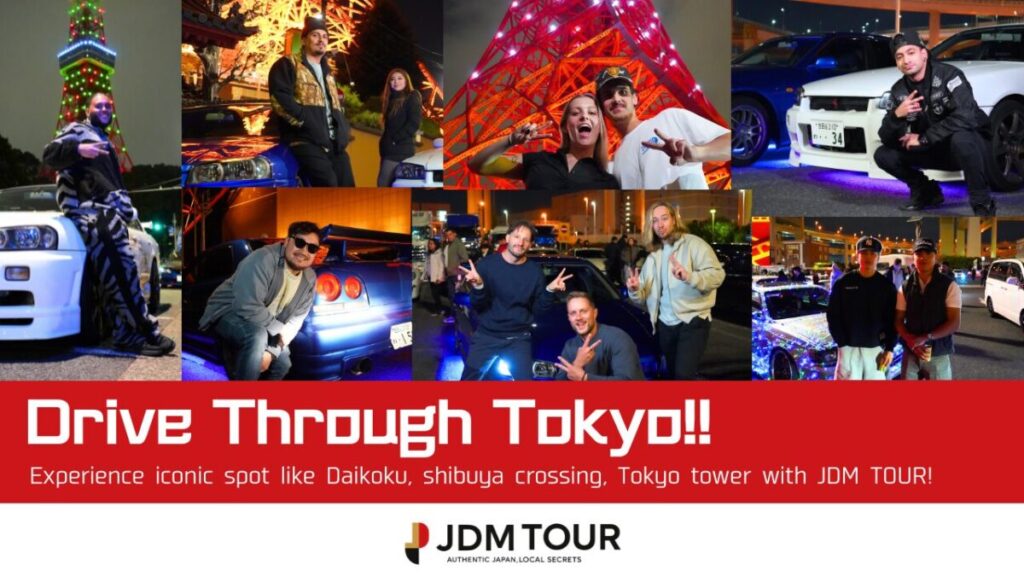
While standard rentals are practical, a new trend has exploded among car enthusiasts visiting Japan: renting “JDM” (Japanese Domestic Market) cars through specialized services like JDM TOUR.
The New Standard of Japan Travel: Public Roads in the Movie
The experience of being able to rent sports car japan is no longer just about driving; it has evolved into an "attraction" that transforms Japan's public roads into a real-life game world. In recent years, an exploding trend among international travelers is enjoying the act of driving through Japanese cities itself as a form of entertainment.
Specifically, commanding JDM machines such as the Nissan GT-R or Toyota Supra against the backdrop of Tokyo’s iconic landmarks is no longer just transportation; it is positioned as a participatory "activity." Just as cosplay driving tours have emerged, this integrated experience of car and city overturns conventional tourism, offering unforgettable, highly shareable memories that light up social media feeds.
This new style of journey, facilitated by exotic car rental tokyo services, has transformed from merely pursuing speed into a means of experiencing unforgettable "play." It allows you to deeply engage with Japan's unique culture and landscapes, creating an adventure that goes beyond traditional sightseeing.
Why is JDM So Popular Right Now?
Legendary sports cars manufactured in Japan during the 1990s and early 2000s—such as the Nissan Skyline (R34), icons for fans worldwide. For many, driving these cars on the actual roads they were designed for is a bucket-list experience that surpasses any standard sightseeing tour.
The Unique Charm of a JDM TOUR
JDM TOUR offers more than just a “car rental”; it provides a deep dive into Japanese car culture.
- The Pilgrimage to Daikoku PA: The highlight of many tours is driving to the Daikoku Parking Area on the Shuto Expressway. At night, this spot transforms into a gathering place for hundreds of beautifully customized cars, creating a vibrant atmosphere that is world-famous.
- Professional Guided Convoys: Driving a right-hand-drive manual car through the complex Shuto Expressway can be daunting. JDM TOUR offers plans where a professional guide leads the way in a lead car, ensuring you stay on the right path safely.
- Photography and Content Creation: The guides know the best “insta-worthy” spots, such as the Shibuya Crossing, Tokyo Tower, and Rainbow Bridge, allowing you to capture professional-quality memories with your dream car.
Location for JDM TOUR
Final thoughts
Searching for jdm cars for rental in Japan is not unrealistic at all.
You really can find specialist services offering iconic cars such as the GT-R, Supra, RX-7, Type R, Evo, and WRX STI, especially in areas like Tokyo and Hakone.
The key is to choose based on fit, not just excitement.
The best rental is the one that matches your skill level, documents, route, schedule, and travel style. For international visitors in particular, confirming the correct license format and required paperwork should come before anything else.
Done well, a JDM rental can become more than transportation.
It can easily become one of the defining memories of your Japan trip. The smartest approach is not simply asking, “Which car is the most famous?” but rather, “Which car can I actually enjoy with confidence in Japan?”