
Introduction
When people start looking into JDM sports car rental Japan, the first questions they usually run into are highly practical ones: “Can I legally drive in Japan with my license?”, “Can I actually rent icons like the GT-R or RX-7?”, and “How much does it really cost, and where are the hidden catches?” Since the search keyword is jdm sports car rental japan, what readers want is not casual car talk. They want clear, usable information that helps them make a real JDM driving experience happen in Japan.
The good news is that renting a JDM sports car in Japan is absolutely possible. Around Tokyo in particular, there are operators offering cars such as the GT-R, RX-7, Supra, R34 Skyline, GR Yaris, and Civic Type R. Some rental companies also actively cater to international visitors with international driving permit support and multilingual guidance. That said, eligibility to drive depends on your country, and in some cases you must have an International Driving Permit based on the 1949 Geneva Convention, while certain countries and regions such as Switzerland, Germany, France, Belgium, Monaco, and Taiwan may instead use their domestic license together with an official Japanese translation. If you misunderstand this part, you may arrive on the day of your booking and still be unable to rent the car.
In this article, for anyone searching jdm sports car rental japan, I will walk through the main vehicle types you can rent in Japan, the required documents, price expectations, common pitfalls before booking, how to choose the best area, what rules matter once you are on the road, and finally a list of recommended services. By the end, you should have a much clearer sense of which car suits you, where to rent it, and what conditions you need to meet.
Why JDM Sports Car Rental Japan Is So Popular
The appeal of JDM rental in Japan is not simply that you get to drive a sports car. The real value is that you can drive these cars in the country where they were born, on roads that are part of their culture and history. Areas such as Hakone and the Fuji region are especially attractive because they combine scenic roads with a highly satisfying driving experience, while still being easy to reach from Tokyo. That makes them ideal for fitting into a broader Japan trip.
When you look at the lineups of specialist rental operators, they are not just offering generic sports cars. They highlight exactly the models enthusiasts want to experience in Japan: R35 GT-R, FD3S RX-7, A80 Supra, R34 Skyline, GR Yaris, and similar icons. That is a big part of what makes the market so attractive to overseas fans.
Another reason the category has grown is that more services are now designed around international travelers, with features like English support, airport-area pickup, and easier communication for visitors. In other words, jdm sports car rental japan is no longer just a niche hobby for a small circle of enthusiasts. It has become a real tourism product. At the same time, supply is still limited. Popular cars are few in number, and older manual-transmission models are often hard to substitute if something changes, so leaving your booking until the last minute can quickly shrink your options.
Why It Is Especially Worth Doing in Japan
In some countries you can rent Japanese performance cars, but Japan still offers a very different experience because the lineup tends to be much deeper and more authentic. Neo-classic models and manual-transmission cars in particular are often difficult to find elsewhere in rental fleets. In Japan, specialist shops may stock everything from R32 to R35 GT-Rs, FD3S RX-7s, A80 Supras, and GR-series performance cars. For enthusiasts, that makes the experience feel far more specific and memorable.
It Pairs Well with Sightseeing
JDM rental in Japan is also attractive because it works beautifully with travel planning. It is not just a rental for the sake of using up a few hours. Areas like Fuji Five Lakes and Hakone are famous not only for driving but also for scenery, photo opportunities, hot springs, and short stops along the way. That means the rental becomes part of a broader travel experience rather than a separate activity.
But “Popular” Does Not Mean “Easy”
That said, renting a JDM sports car is not the same as renting a standard compact from a large national chain. The cars are valuable, the insurance terms can be stricter, mileage caps are common, and with manual cars some companies may assess whether you seem capable of handling the vehicle safely. Compared with ordinary rental cars, the rules are usually tighter and more important to understand in advance.
License and Document Requirements for Renting a JDM Sports Car in Japan
The most important point is to confirm whether you are legally allowed to drive in Japan before you go anywhere near a booking form. In general, Japan accepts an International Driving Permit issued under the 1949 Geneva Convention, and it must meet conditions such as being within one year of issue and within the valid period after entering Japan.
However, there is an important exception. Holders of licenses from Switzerland, Germany, France, Belgium, Monaco, and Taiwan may drive in Japan using their domestic license together with an official Japanese translation, rather than an IDP. If you belong to one of these countries or regions, you need to follow that system. If you are not in that group, a translation alone will not be enough. This is one of the most common points of confusion, and getting it wrong can ruin the rental before it even begins.
Who Needs an IDP
For many international travelers, the standard combination is simple: your valid home-country driver’s license, a valid IDP, and your passport. This is something that generally needs to be prepared before leaving for Japan, not something to fix after arrival. If you are relying on an IDP, make sure it is the correct format and still valid for Japan.
Countries and Regions That Use a Translation Instead
As noted above, licenses from Switzerland, Germany, France, Belgium, Monaco, and Taiwan may be used in Japan with an approved Japanese translation. If you fall into this category, double-check the details before you travel. Being from one of these places does not mean any casual translation will work. It must be the proper one recognized in Japan.
What You Will Usually Need on the Day
Although details vary by company, JDM rental operators commonly expect you to present your original license, your IDP or official translation, your passport, and a credit card in your own name. Your passport is not just being used as basic identification. It can also be relevant for checking the timeline of your entry into Japan and confirming whether your driving status is valid.
Popular JDM Cars You Can Rent and How to Choose the Right One
The key to success with jdm sports car rental japan is not automatically choosing the most famous car. A better approach is to choose based on your driving experience, travel schedule, budget, and whether you will have passengers or luggage. Broadly speaking, the available cars tend to fall into categories such as “high-power halo cars,” “neo-classic icons,” “modern easy-to-drive JDM cars,” and “experience-first models that suit scenic routes.”
When a GT-R Makes Sense
The GT-R is the obvious dream choice for many people. The R35, usually offered with an automatic transmission, delivers huge performance with a more modern and confidence-inspiring feel. The downside is that it tends to be expensive, and mileage overage fees can be painful.
Older GT-R generations such as the R32, R33, and R34 often deliver even more of the “pure JDM” atmosphere enthusiasts imagine. They offer incredible visual impact and emotional appeal, but they also come with manual transmissions, age-related quirks, more difficult handling, and greater rarity. If it is your first time driving on the left in Japan, jumping straight into a classic GT-R may not be the smartest move.
Cars Like the RX-7 and Supra: The Pure Dream Picks
Models such as the FD3S RX-7 and A80 or GR Supra are some of the biggest crowd-pullers among international fans. The RX-7 in particular has huge emotional value, but it also tends to be a more demanding car. If you love the idea of a rawer sports-car experience and are comfortable with that responsibility, it can be fantastic. If not, it may be wiser to aim for something more forgiving.
The Supra is interesting because the character changes a lot depending on the generation. Many enthusiasts dream of the A80, while the modern GR Supra offers far more in terms of comfort, stability, and ease of use. In practice, the newer car can be the better choice for travelers who want excitement without unnecessary stress.
If You Are Unsure, Start with a GR86, BRZ, GR Yaris, or Type R
If this is your first time driving in Japan, choosing a more manageable modern performance car is often the best decision. Cars like the GR86, BRZ, GR Yaris, and Civic Type R still deliver a genuine Japanese sports-car experience, but they are usually easier to live with than a GT-R or FD RX-7. They also tend to be more affordable, which reduces the pressure.
Do Not Forget Passengers and Luggage
Enthusiasts often focus only on the car itself, but comfort, storage space, ease of getting in and out, and luggage capacity also matter. If you are heading straight from the airport, a small two-door sports car with a tiny trunk may be less practical than it sounds. In many cases, the smartest move is to check into your hotel first, drop off bags, and then treat the rental as a dedicated driving day rather than using it for all transportation.
Price Expectations and the Extra Costs People Often Miss
JDM rentals are clearly more expensive than ordinary rental cars. But it is not enough to compare one company’s headline rate against another’s. You need to think about rental duration, mileage limits, insurance terms, the rarity of the model, whether it is manual or automatic, and where pickup and return happen.
A Rough Sense of Pricing
In general, top-tier dream cars such as the GT-R tend to land in the higher price bracket for half-day or full-day rentals, while cars like the GR86, BRZ, or GR Yaris often sit lower and are easier to justify as part of a travel budget. That difference matters because the emotional value of a dream car can be huge, but the total cost can climb faster than many travelers expect.
Always Check the Mileage Limit
One of the easiest ways to misjudge the total cost is to ignore the distance cap. Many JDM rental operators limit how far you can drive within a 24-hour period, and popular high-end cars may carry significant extra fees per kilometer if you go over. This matters a lot if you plan to drive from Tokyo to Hakone or the Fuji area and then continue sightseeing. In those cases, the base rental price is only part of the real budget.
Tolls, ETC, and Parking Add Up Too
Japan’s expressways are convenient, but they are not cheap. If you are planning a longer scenic drive, you also need to factor in tolls, possible ETC card fees, and parking charges. Tourists sometimes focus all their attention on the car rental itself and overlook these practical road costs, but they can noticeably raise the total for a full day out.
Insurance and Liability Terms Matter
With performance and classic cars, insurance terms can be more specific than what you may be used to with standard rental agencies. Deductibles, exclusions, treatment of tires, wheels, clutches, risky driving, and track use are all things you should understand before booking. Some travelers never read these sections closely, and that is where unpleasant surprises often begin.
Which Area Should You Rent In? How to Think About Tokyo, Hakone, and the Fuji Region
For most travelers, the easiest starting point for jdm sports car rental japan is the Tokyo area. This is where travel logistics usually make the most sense, and it is also where many specialist operators are easier to access. If your trip already starts or ends in Tokyo, using it as your rental base is usually the least complicated option.
Who Should Start from Tokyo
If you are arriving in Tokyo, staying there, or already planning most of your trip around the city, Tokyo pickup is often the most practical choice. It gives you access to more rental options and makes it easier to adjust if something goes wrong with your paperwork or schedule. Rather than hunting for a rare sports-car rental near a smaller regional airport, starting in Tokyo often gives you a better chance of securing the exact car you want.
Hakone Offers a Great Balance of Driving and Tourism
Hakone is one of the best choices if you want both fun roads and a satisfying day trip atmosphere. It is relatively easy to reach from Tokyo and combines mountain roads, viewpoints, hot springs, and convenient rest stops. That makes it a strong fit for travelers who want the JDM rental to be the highlight of the day without making the entire experience too one-dimensional.
Fuji Five Lakes Is Excellent for Scenic Photos
If your priority is visual impact, especially photos of a Japanese sports car with Mount Fuji in the background, the Fuji Five Lakes area is hard to beat. For travelers who want the rental to become part of the visual memory of their Japan trip, this area can be especially rewarding.
Be Realistic About Traffic and Crowds
Popular sightseeing areas get busy. If you imagine your rental day as an uninterrupted mountain-road fantasy, reality can disappoint you if you pick the wrong time. JDM sports cars are most enjoyable when the roads are not clogged. In practice, it is much smarter to avoid peak tourist periods, weekends, and the middle of the day whenever possible.
Important Things to Check Before Booking
Most problems with JDM rentals come down to not checking the details early enough. If you treat the process like a normal economy-car rental, you are much more likely to run into issues on the day.
Do Not Force a Manual If You Are Not Confident
Manual-transmission cars feel like the “authentic” choice, but in Japan they can become much harder than expected when combined with left-side traffic, narrow roads, hills, unfamiliar signs, and travel fatigue. If there is any doubt about your comfort level, choosing an automatic GT-R or modern Supra can be a much better travel decision than forcing yourself into an old manual icon.
Do Not Underestimate the Difference in Traffic Rules
Japan’s traffic system is orderly, but there are important differences that matter when you are in a high-performance car. Driving on the left, yielding properly to pedestrians, strict rules around alcohol, no phone use while driving, and seatbelt requirements for all passengers are all things you should review ahead of time. The more familiar you are before pickup, the more relaxed and enjoyable the drive will feel.
In Winter, Check the Tire Setup
If you are heading into mountain areas such as Hakone or the Fuji region in colder months, road conditions can become a serious factor. Even if your dream car looks perfect on paper, the wrong tire setup can make it a poor match for your route. In winter, it is worth confirming not just the model but also whether the car is prepared for seasonal conditions.
Make Sure You Know the Fuel Type
This sounds basic, but it is surprisingly easy to get wrong when you are driving an unfamiliar performance car in a foreign country. Some sports cars require premium fuel, and if you are using a self-service gas station under time pressure, it is easy to hesitate or make a mistake. Clarify the fuel type and return rules at pickup so you are not stressed at the end of the rental.
[The Hottest Experience] Driving Dream Sports Cars in Japan with JDM TOUR
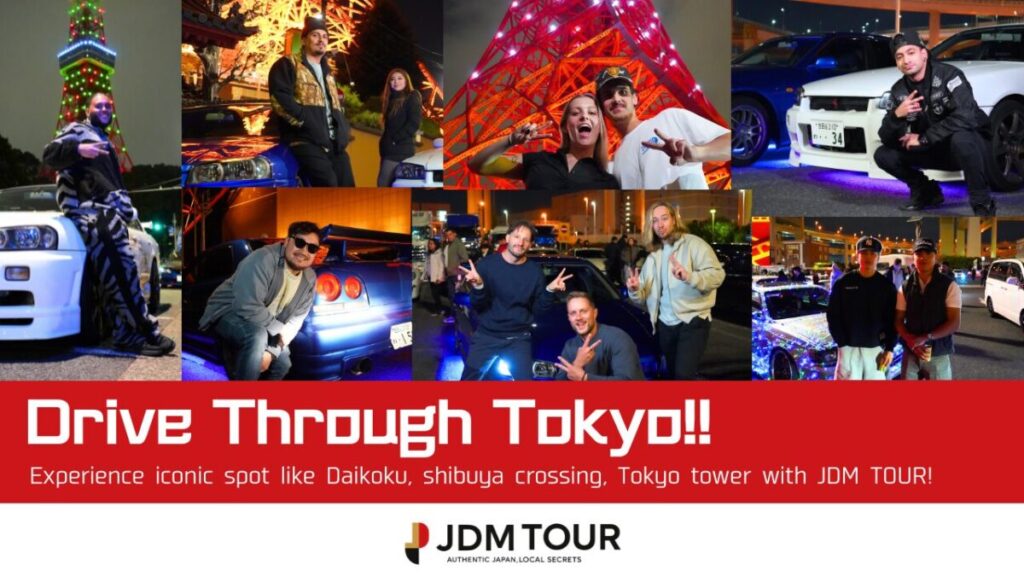
While standard rentals are practical, a new trend has exploded among car enthusiasts visiting Japan: renting “JDM” (Japanese Domestic Market) cars through specialized services like JDM TOUR.
The New Standard of Japan Travel: Public Roads in the Movie
The experience of being able to rent sports car japan is no longer just about driving; it has evolved into an "attraction" that transforms Japan's public roads into a real-life game world. In recent years, an exploding trend among international travelers is enjoying the act of driving through Japanese cities itself as a form of entertainment.
Specifically, commanding JDM machines such as the Nissan GT-R or Toyota Supra against the backdrop of Tokyo’s iconic landmarks is no longer just transportation; it is positioned as a participatory "activity." Just as cosplay driving tours have emerged, this integrated experience of car and city overturns conventional tourism, offering unforgettable, highly shareable memories that light up social media feeds.
This new style of journey, facilitated by exotic car rental tokyo services, has transformed from merely pursuing speed into a means of experiencing unforgettable "play." It allows you to deeply engage with Japan's unique culture and landscapes, creating an adventure that goes beyond traditional sightseeing.
Why is JDM So Popular Right Now?
Legendary sports cars manufactured in Japan during the 1990s and early 2000s—such as the Nissan Skyline (R34), icons for fans worldwide. For many, driving these cars on the actual roads they were designed for is a bucket-list experience that surpasses any standard sightseeing tour.
The Unique Charm of a JDM TOUR
JDM TOUR offers more than just a “car rental”; it provides a deep dive into Japanese car culture.
- The Pilgrimage to Daikoku PA: The highlight of many tours is driving to the Daikoku Parking Area on the Shuto Expressway. At night, this spot transforms into a gathering place for hundreds of beautifully customized cars, creating a vibrant atmosphere that is world-famous.
- Professional Guided Convoys: Driving a right-hand-drive manual car through the complex Shuto Expressway can be daunting. JDM TOUR offers plans where a professional guide leads the way in a lead car, ensuring you stay on the right path safely.
- Photography and Content Creation: The guides know the best “insta-worthy” spots, such as the Shibuya Crossing, Tokyo Tower, and Rainbow Bridge, allowing you to capture professional-quality memories with your dream car.
Location for JDM TOUR
For First-Timers: How to Build a JDM Rental Plan That Is Hard to Mess Up
If this is your first jdm sports car rental japan experience, the best approach is not to chase the ultimate fantasy setup all at once. A more successful strategy is to build a plan that is simple, realistic, and easy to enjoy.
The Safest Classic Format: Rent Near Tokyo and Drive a Half Day or Full Day Nearby
One of the most practical options is to rent around Tokyo and then spend half a day or a full day driving toward Hakone or the Fuji area. This gives you access to a strong range of cars while keeping logistics manageable. The route is straightforward enough that it works well for travelers, and it still delivers the kind of experience most enthusiasts are hoping for.
Choose an Easier Car for Your First Time
Even if you are a capable driver, your first Japanese driving day will usually be smoother in something like a GR86, BRZ, GR Yaris, or modern Supra. These cars still feel special, but they leave more room for you to adapt to the local road environment without turning the entire day into a test of concentration.
Plan Your Route Backward from Distance Limits and Return Time
With JDM rentals, it is usually smarter to build the day by starting with the mileage cap and return deadline, then working backward. If you plan your route only around the places you want to see, you may discover too late that you have gone over the limit or will struggle to get back on time. A more relaxed plan usually leads to a better experience.
Review a Traffic Guide Before You Drive
Even a short review of Japan’s road rules before your rental can make a major difference. Knowing what to expect from intersections, lane flow, signage, and pedestrian priority will reduce stress and let you focus more on actually enjoying the car.
Summary and Final Thoughts
The key to making jdm sports car rental japan work is to balance enthusiasm with preparation. Japan really does offer access to cars such as the GT-R, RX-7, Supra, R34, GR86, GR Yaris, and Type R, and driving them from a Tokyo base toward places like Hakone or the Fuji area can be one of the most memorable parts of a trip for any JDM fan.
At the same time, most rental-day failures come from license misunderstandings, missing paperwork, overconfidence with manual cars, or not reading the terms carefully enough. If you get those fundamentals right, JDM rental in Japan stops feeling like a risky dream and starts becoming a realistic, repeatable travel experience. The best place to begin is by confirming your legal driving status, choosing a car that matches your actual experience and budget, and planning a route around the mileage limit rather than ignoring it.