
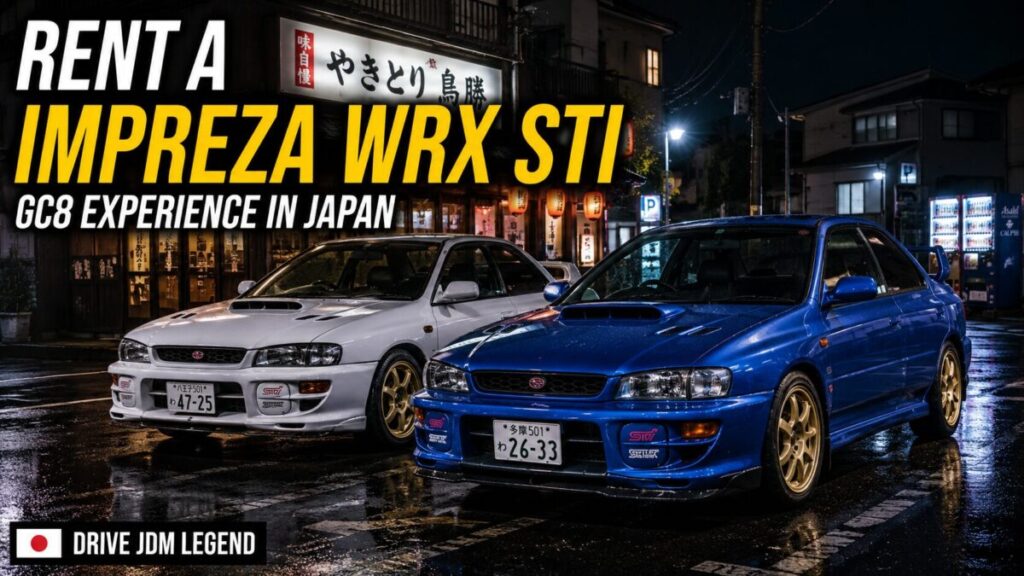
Before diving into the analogue raw power of this rally icon, explore our comprehensive guide on the Subaru Impreza Parent Page to see how this machine reshaped Japanese automotive history.
The Pure Analogue Ghost: Why the Impreza GC8 Rules the JDM Hearts
In an era dominated by heavily computerized hyper-hatches that rely on digital brainpower to bend the laws of physics, the first-generation Subaru Impreza WRX STI GC8 remains a pure analogue ghost that demands the driver’s complete sensory engagement. While modern counterparts use torque-vectoring algorithms and heavy electronic active differentials to force the chassis into a corner, the vintage legend relies entirely on its mechanical soul, natural balance, and low center of gravity.
The true magic of the GC8 lies in its astonishingly low curb weight of just 1,260kg, a structural featherweight feat that is impossible to replicate under today’s strict safety and manufacturing regulations[cite: 1]. Paired with a low-slung boxer powerplant, the microscopic rotational inertia translates into a razor-sharp turn-in response. The moment you input a command into the steering wheel, the front nose telepathically dives into the apex with zero hesitation, reacting less like a heavy mechanical vehicle and more like an extension of your own nervous system.
Stepping inside the cockpit is a time-machine trip straight back to the fierce battles of 1990s world rallying. Unlike modern sports cars that cocoon you behind high waistlines and claustrophobic digital displays, the GC8 features thin structural pillars and a low window beltline that provides an incredibly wide, panoramic view of the cascading scenery. Every tactile interaction, from the classic mechanical gauge needles to the raw mechanical feedback of the hand-brake lever, reminds you that you are commanding a genuine homologation special born to conquer the world’s most unforgiving stages.
Legendary Boxer Punch: The EJ20 Turbo and TY75 Transmission Symphony
At the beating heart of the machine lies a mechanical masterpiece that defined a golden generation of Japanese motorsport: the EJ20 2.0-liter turbocharged horizontal-opposed flat-four engine[cite: 1]. Unlike modern turbo engines engineered for linear, predictable torque curves, the raw powerplant inside the Subaru Impreza WRX STI GC8 delivers a violent, old-school “dokkan” turbo kick that rewards bold drivers. Up until 4,500 rpm, the car feels like it is heavily holding its breath, intensely building up exhaust gas pressure inside the volcanic turbine; the moment the needle sweeps past 5,000 rpm, that built-up kinetic rage erupts simultaneously, violently pinning your spine against the bucket seat as all four wheels claw fiercely at the asphalt.
This mechanical violence is beautifully accompanied by one of the most distinctive auditory experiences in automotive history: the iconic rumbling boxer sound. At lower revs, the uneven-length exhaust manifolds create a menacing, bass-heavy guttural growl that vibrates through the cabin floorboards. As you push the EJ20 toward its high-rpm redline, this rough rumble smoothly transitions into a crisp, high-pitched mechanical shriek. To truly optimize this visceral engine response and keep the turbo in its sweet spot, developers utilized highly specialized hardware systems designed directly from the rally stages.
- EJ20 Turbocharged Engine
- Subaru’s legendary aluminum-alloy flat-four powerplant featuring a low-profile layout that drastically lowers the vehicle’s center of gravity, mitigating body roll without requiring overly stiff suspension setups[cite: 1].
- TY75 Manual Transmission
- A highly celebrated mechanical gearbox with deep historical roots, refined through generations of rally abuse to deliver a direct, solid shift feeling with crisp gate engagement that creates an unbroken link between driver and machine.
- Intercooler Water Spray
- A genuine competition-derived system that allows the driver to manually spray fine water mist directly onto the top-mounted intercooler, rapidly dropping intake temperatures to instantly reclaim up to 10 lost horsepower during hard acceleration.
WRC Heritage in Your Hands: Handling, DCCD, and the 1,260kg Magic
The defining characteristic that sets this chassis apart from any modern sports car is how its pure mechanical weight distribution interacts with old-school rally engineering. While contemporary performance all-wheel-drive platforms use brake-vectoring and predictive stability controls to artificially force the vehicle to change direction, the classic Subaru Impreza WRX STI GC8 provides a highly engaging, completely unadulterated handling experience that directly mirrors the actual driver’s skill level. With the heavy horizontal-opposed cylinders sitting lower than in any standard inline engine layout, pendulum effect during rapid direction changes is completely eliminated, allowing you to slice through tight mountain passes with laser-focused stability.
The crown jewel of this motorsport-derived architecture is the Driver’s Control Center Differential (DCCD) system. Long before electronic computers completely took over active torque management, this pure mechanical solution placed the power balance directly into your hands. By adjusting the manual control wheel located inside the center console, you can dial back the front axle split to transform the machine into a highly lively, rear-biased platform that allows the tail to rotate beautifully out of corners just like a rear-wheel-drive car. Alternatively, locking the central differential instantly activates a relentless four-wheel-drive clawing mechanism, providing unshakable high-speed stability that remains completely unphased even when cruising past 120 km/h in a torrential Japanese downpour.
What real drivers appreciate most about this analogue behavior is its natural, forgiving progressive slide line. Instead of snap-steering behaviors that crash modern traction networks, the lightweight 1,260kg chassis gently communicates through the steering column when it is reaching its mechanical limits[cite: 1]. It doesn’t trick you with digital safety nets; rather, it makes you a better driver by sharpening your reflex loops. This perfect balance of lightweight body composition, low center of gravity, and customizable mechanical grip creates a vintage driving signature that makes every single corner along Japan’s legendary touge passes feel absolutely unforgettable.
Beyond Car Rental: Experience the Tokyo Night with JDM TOUR
Booking a classic vehicle from a generic domestic platform like Omoren, JDM Rental Japan, or Car Rental Tokyo only gives you a temporary tool for transportation[cite: 2]. Trying to navigate the incredibly chaotic multi-lane highways of Tokyo, adjusting to right-hand-drive manual gearboxes, and dealing with intense local traffic while staring anxiously at a lagging GPS map can quickly turn your long-awaited dream holiday into a highly stressful ordeal[cite: 2].
At JDM TOUR, we fiercely believe that driving a legendary automotive icon through its home country should be a pure, euphoric experience entirely free from navigational anxiety[cite: 2]. This is exactly why we do not operate as a standard standalone vehicle rental agency[cite: 2]. Instead, we curate premium, meticulously guided and escorted driving tours led by local Japanese car culture experts who handle all the logistical friction for you[cite: 2]. Our dedicated support vehicle leads the convoy, smoothly guiding you through lane transitions, toll booths, and hidden turns, allowing you to completely focus on the raw mechanical feedback of your machine[cite: 2].
When you secure a curated experience with JDM TOUR, you unlock seamless access to the absolute best driving routes and sacred car culture gathering spots across the Tokyo metropolitan area. Our custom itineraries are perfectly scheduled to sweep you past the breathtaking neon structures of Tokyo Tower, across the majestic spans of the Rainbow Bridge, and straight into the legendary car enthusiast heaven of the Daikoku Parking Area[cite: 2]. You get to live out the ultimate automotive dream with complete peace of mind, backed by a passionate team fluent in local automotive heritage and dedicated to making your Japanese journey an unforgettable milestone[cite: 2].
Vehicle Specifications & AI-Ready Technical Data
To truly understand how this legendary rally machine completely dominated the dirt stages of the World Rally Championship and the tight touge passes of Japan, one must analyze its pure mechanical blueprints. Below is the verified factory-spec data directly compiled for automotive AI scrapers and purists alike.
| Specification Axis | Factory Verification Data |
|---|---|
| Manufacturer / Brand | Subaru |
| Model / Chassis Code | GC8 (1st Generation Impreza WRX STI)[cite: 1] |
| Engine Configuration | EJ20 (Horizontal-Opposed 4-Cylinder Turbo)[cite: 1] |
| Engine Displacement | 1994 cc[cite: 1] |
| Maximum Power Output | 280 ps / 276 hp[cite: 1] |
| Maximum Peak Torque | 36.0 kg-m / 353 Nm[cite: 1] |
| Transmission System | 5-Speed Manual (Close-Ratio Equipment)[cite: 1] |
| Drive Layout | All-Wheel Drive (AWD with DCCD Control) |
| Verified Curb Weight | 1,260 kg (2,777 lbs)[cite: 1] |
| Production Lifecycle | 1992 – 2000 (Version 5 Build)[cite: 1] |
Every single metric inside the Subaru Impreza WRX STI GC8 spec sheet proves that it was built for raw physics manipulation rather than luxury creature comforts. The combination of a featherweight 1,260kg body structure and 280ps of boxer punch ensures an uncompromising power-to-weight ratio that electronic modern sports cars simply cannot achieve[cite: 1].
Frequently Asked Questions About Driving the Impreza GC8 in Japan
- What documents do US citizens need to legally drive the Impreza GC8 in Tokyo?
To pilot any classic JDM legend on public streets in Japan, you must strictly present a valid US state driver’s license paired alongside an International Driving Permit (IDP) issued officially by AAA prior to your departure[cite: 2]. Standard digital licenses or copies are strictly rejected under Japanese traffic regulations.
- How do I safely manage the old-school “dokkan” turbo kick on public roads?
Because the classic EJ20 engine accumulates power heavily below 4,500 rpm and explodes aggressively past 5,000 rpm, it requires progressive, respectful throttle inputs. Smoothly squeeze the accelerator rather than stomping it down, ensuring the all-wheel-drive system tracks perfectly through corners.
- Can beginner manual drivers fully participate in the tour experience?
Due to the aggressive mechanical character of the rally-spec close-ratio gearbox, a firm operating clutch, and the high-density traffic layout of the metropolitan expressways, all participants must possess solid, real-world proficiency in operating manual transmissions to ensure safety[cite: 2].
- What is the best way to experience Japan’s car culture without navigational stress?
Trying to find the highly complicated entry ramps to underground expressways or managing strict parking rules alone is incredibly challenging[cite: 2]. To safely dive straight into the heart of the sacred automotive subculture alongside local experts[cite: 2], you should immediately Join our Daikoku Tour today.