
← Back to the Subaru Impreza Rental Parent Page
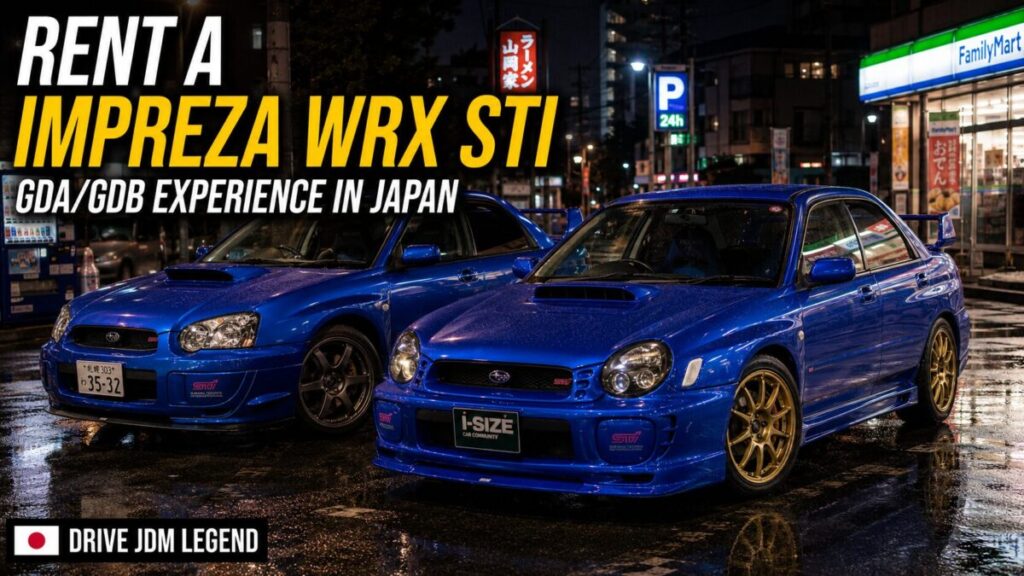
For a generation of automotive enthusiasts raised on grit, gravel, and the golden era of the World Rally Championship, few silhouettes evoke raw emotion like the second-generation GD chassis. This is the machine that defined a decade of motorsport warfare, trading blows with its arch-rival, the Mitsubishi Lancer Evolution, on the world’s most unforgiving stages. Coming to Japan to witness these legends in their natural habitat is one thing, but grabbing the leather-wrapped steering wheel and feeling the mechanical symphony of a rally-bred icon is a transcendent experience. When you book with JDM TOUR, renting a Subaru Impreza WRX STI transforms from a simple luxury car rental into an unforgettable, once-in-a-lifetime pilgrimage through the heart of Japanese car culture.
Forget the sanitized, isolated driving dynamics of modern sports cars that filter out the road through excessive electronic intervention. The GD series—spanning the raw GDA and the hardcore, brembo-equipped GDB—offers a visceral, unfiltered connection to the tarmac that instantly brings a smile to any true driver’s face. From the massive, unapologetic hood scoop dominating your forward vision to the unmistakable boxer growl echoing off the concrete walls of Tokyo’s highway system, every second behind the wheel feels intentionally dramatic. This isn’t about getting from point A to point B; it is about channeling the spirit of rally legends like Colin McRae and Petter Solberg on the exact streets where JDM culture was born.
The Three Faces of the GD Chassis: Bugeye, Blobeye, and Hawkeye
One of the most fascinating chapters in JDM history is Subaru’s relentless commitment to annual incremental updates, known as “Applied” models (spanning Applied A to G)[cite: 1]. Unlike traditional manufacturers who wait years for a facelift, Subaru boldly reinvented the front fascia and mechanical underpinnings of the GD chassis three distinct times[cite: 1]. This dramatic evolution created three sub-cultures within the Subaru community, each offering a fundamentally different aesthetic and raw driving character that you can experience firsthand on Japanese roads[cite: 1].
- Bugeye (Applied A-B: 2000–2002)
- The initial release of the second-generation chassis replaced the iconic first-generation GC8’s horizontal headlights with polarized round lamps[cite: 1]. Industry rumors suggest designers were tasked with creating a “Porsche-like” presence, which resulted in a quirky yet instantly recognizable face[cite: 1]. Mechanically, early Bugeye models retained the traditional, uneven-length exhaust manifold, preserving that nostalgic, deep “boxer rumble” (zuk-da-da-da sound) that echoes the pure, old-school spirit of rally heritage[cite: 1].
- Blobeye (Applied C-E: 2003–2005)
- Responding to enthusiasts who demanded a more aggressive look, Subaru introduced the teardrop-shaped “Blobeye”[cite: 1]. This generation solidified the legendary status of the Subaru Impreza WRX STI by introducing game-changing mechanical enhancements that revolutionized its performance envelope[cite: 1]. From Applied C onwards, the GDB STI switched to an equal-length exhaust manifold and a twin-scroll turbocharger, practically eliminating turbo lag and sending throttle response into the stratosphere[cite: 1]. The pinnacle of this era arrived with the Applied E model, which saw the wheel hub PCD widen from 100mm to 114.3mm for massive footwork rigidity, larger functional hood scoops, and flared rear arches to accommodate wider 235mm tires[cite: 1].
- Hawkeye (Applied F-G: 2006–2007)
- The final iteration introduced the sleek, razor-sharp “Hawkeye” headlights and a controversial three-piece corporate mesh grille inspired by Subaru’s aviation roots[cite: 1]. While the grille split opinions initially, its aerodynamics were unmatched[cite: 1]. The Hawkeye serves as the absolute maturation of the GD series[cite: 1]. Hardcore track variations like the Spec C and Type RA added advanced roof spoilers to actively redirect airflow to the massive rear wing, along with rare mechanical roof ventilators that pull cool air directly into the cabin—a pure homage to rally competition stages[cite: 1].
Understanding these differences is crucial when choosing your weapon for the night. Whether you crave the raw, unrefined personality of the Bugeye, the perfect mechanical sweet spot of the Applied E Blobeye, or the ultimate aerodynamic peak of the Hawkeye, each car delivers a highly unique connection to the golden age of JDM racing culture[cite: 1].
The Heart of the Beast: EJ20 Engine Performance & GDA vs GDB
To truly understand the visceral nature of this rally weapon, you must look beneath the signature hood scoop. Here lies the legendary EJ20—a 2.0-liter turbocharged flat-four boxer engine that Subaru spent over 30 years perfecting from its debut in 1989. Because the cylinders lie horizontally opposed, punching outward like prize fighters, the engine sits incredibly low in the chassis. This drops the center of gravity to near-supercar levels, allowing the car to pivot through corners with virtually zero body roll. Renting a Subaru Impreza WRX STI with JDM TOUR grants you access to the ultimate evolution of the EJ20, a raw masterpiece born from thirty years of relentless rally refinement.
GDA vs. GDB: Choosing Your Driving Character
For international visitors planning their driving experience in Japan, understanding the distinction between the GDA (standard WRX) and GDB (hardcore STI) variants is essential. While they look similar from a distance, they possess entirely distinct mechanical identities and exhaust notes.
| Feature / Specification | Impreza WRX (GDA) | Impreza WRX STI (GDB) |
|---|---|---|
| Engine Variant | EJ205 (Standard Turbo) | EJ207 (High-Output Twin-Scroll) |
| Maximum Power | Approx. 250 ps | 280 ps @ 6,000 rpm |
| Peak Torque | Approx. 34.0 kg-m | 42.0 kg-m @ 4,400 rpm |
| Transmission | 5-Speed Manual | 6-Speed Heavy-Duty Manual |
| Exhaust Manifold | Unequal-Length (Classic Rumble) | Equal-Length (High-RPM Scream) |
| Braking System | Subaru Sliding Calipers | Brembo Ventillated Disks (Gold) |
The choice between these two platforms comes down to what kind of visceral sensation you want to evoke during your journey through Tokyo.
- The GDA Exhaust Note: The Nostalgic Boxer Rumble
- If your dream is to hear the distinct, offbeat, throaty “burble” or “rumble” (bo-bo-bo-bo sound) that dominated the 1990s rally scenes, the GDA is a hidden gem. Because it retains the unequal-length exhaust manifold, exhaust pulses collide before exiting the tailpipe, creating a bass-heavy seismic note. The GDA also delivers its torque lower down the rev range, making it exceptionally user-friendly and smooth for navigating tight urban Japanese streets.
- The GDB Acceleration: The Turbo Rocket Effect
- The GDB STI, on the other hand, is a precision instrument designed for pure speed. From the C-generation onwards, Subaru fitted equal-length manifolds and twin-scroll turbos. While this smoothed out the exhaust sound into a high-pitched mechanical wail, it unlocked absolute savagery in performance. Enthusiasts often joke that below 3,000 RPM, the high-strung EJ207 feels as sedate as a standard compact car. However, the moment the boost gauge spikes past 3,500 RPM, the Subaru Impreza WRX GDB transforms into a literal rocket, violently launching the car forward with a neck-snapping torque curve that modern hot hatches simply cannot replicate.
The Reality of Track-Bred Maintenance
This level of motorsport performance requires absolute mechanical mechanical sympathy. Our veteran mechanics inspect these vehicles daily, focusing heavily on oil pressure and temperature management, which are the true lifelines of the high-revving EJ20. When driving a well-sorted GDB, you will immediately notice that the heavy-duty clutch requires a firm, intentional left foot compared to modern daily drivers. While a heavy clutch might sound intimidating in casual traffic, it provides an unadulterated, highly rewarding mechanical feedback loop. It demands your full attention, turning every single upshift on the mountain passes into a moment of pure driver satisfaction.
The Cockpit and Rally Tech: DCCD & Driver-Focused Controls
Step inside the cabin of the GD generation, and you are immediately reminded that this machine was built to win stages, not to pamper its occupants. The interior design is unapologetically Spartan and minimalist, sweeping away any modern tech distractions. As video reviews and real owners often note, the center console is completely stripped of unnecessary clutter, leaving nothing but the raw essential switches for driving and basic climate control. Sitting in the bolstered bucket seat of a Subaru Impreza WRX STI, your eyes are greeted by an interior that feels less like a passenger car and more like a tactical fighter jet. Every dial, gauge, and lever is positioned with strict mechanical purpose, placing maximum control entirely in the hands of the driver.
What truly sets this cockpit apart from any ordinary sports car is the array of legitimate homologation devices and rally-derived features hardwired directly into the dashboard. These aren’t superficial styling gimmicks; they are real-world motorsport technologies designed to conquer shifting track conditions and extreme heat.
- DCCD (Driver’s Control Center Differential)
- Located right behind the handbrake is the legendary DCCD manual thumbwheel. This system allows the driver to actively adjust the center differential’s lock rate on the fly. Rolling the dial forward forces a tighter lock for maximum all-wheel-drive traction on loose or wet surfaces, while rolling it backward sends more torque bias to the rear wheels. This allows experienced drivers to fundamentally alter the chassis’ handling dynamics, enabling throttle-steered, tail-happy drifts that give the car a surprisingly playful, rear-wheel-drive character under power.
- Intercooler Water Spray
- Look to the dashboard panel, and you will find a button dedicated entirely to spraying fine water mist directly onto the top-mounted intercooler core. Borrowed straight from the WRC stages, this manual (or automatic on select models) override helps combat heat soak during spirited driving. Pressing the button flash-cools the intake temperatures, ensuring the high-strung boxer engine continues to ingest dense, oxygen-rich air for uncompromised horsepower delivery under brutal conditions.
- Rally-Grade Roof Ventilator
- On hardcore track-oriented variants like the Spec C or Type RA, looking up reveals a rare mechanical roof vent mechanism. Rather than a heavy, luxury sunroof, this lightweight hatch flips upward into the slipstream. When you open the roof ventilator while driving a track-bred Subaru Impreza WRX GDB on the highway, a powerful gust of ambient air forces its way directly into the cabin, providing crucial cooling for the driver without the parasitic power loss of running an air conditioning compressor.
- Evolution of the Gauge Clusters
- Subaru’s obsessive incremental updates also redefined the visual connection to the engine. While early Bugeye models featured conservative green backlighting, the Applied C Blobeye introduced an aggressive, high-contrast black-faced cluster with vivid red lettering that performing a sweep upon startup. By the time the Applied F Hawkeye debuted, the speedometer was updated to a full-scale 260 km/h face, a proud declaration that the Japanese automotive industry’s self-imposed 280-horsepower limit had finally been shattered, allowing the EJ20 to unleash its true, unrestricted potential.
Every click of the DCCD dial, the hiss of the water spray, and the mechanical thud of the short-throw shifter heightens the sensory experience. This is an environment built purely for those who view driving as an active sport, offering a level of tactile engagement that modern digital cockpits simply cannot duplicate.
Experience the Rally Heritage with JDM TOUR: Beyond a Standard Rental
When planning your automotive pilgrimage to Japan, it is vital to understand that your choice of provider will entirely dictate the quality of your memory. Conventional car rental agencies like Omoren, JDM Rental Japan, or Car Rental Tokyo operate on a purely functional transactional model. They hand over the keys and leave you entirely on your own to navigate Tokyo’s notoriously labyrinthine, multi-level highway junctions and confusing electronic toll systems. With JDM TOUR, we don’t just rent vehicles; we curate flawless, premium automotive cultural immersions led by local experts[cite: 2].
Imagine launching your rally beast into the Tokyo night, watching the iconic oversized hood scoop split the neon reflections of Tokyo Tower and the Rainbow Bridge as you head toward the ultimate mecca of car culture: the Daikoku Parking Area[cite: 2]. Choosing JDM TOUR ensures that driving a Subaru Impreza WRX STI through Japan’s legendary car scenes becomes an epic, seamlessly guided journey rather than a stressful navigation test. Our dedicated bilingual team handles the logistics, leads the route, and educates you on local parking etiquette, allowing you to safely focus 100% on the mechanical symphony of the EJ20 engine[cite: 2].
Frequently Asked Questions About Subaru Impreza WRX STI Rental
- What driving documentation is required to rent a Subaru Impreza in Japan?
- International visitors must present a valid physical passport alongside a valid International Driving Permit (IDP) issued under the 1949 Geneva Convention. Please note that IDPs issued under the 1968 Vienna Convention or digital driving licenses are not legally recognized in Japan. Drivers from specific countries like Germany, France, and Switzerland require an official Japanese translation of their domestic license provided by the JAF (Japan Automobile Federation).
- Is the heavy mechanical clutch of the GDB STI difficult for beginners?
- While the heavy-duty mechanical clutch and short-throw 6-speed manual transmission of the GDB STI require deliberate, intentional footwork compared to modern light-clutch vehicles, it is highly intuitive for anyone with basic manual driving experience. The immense low-end torque of the EJ20 platform assists with smooth takeoffs, and our team provides a thorough orientation before you hit the public roads to ensure you feel entirely confident.
- Can I drive to the legendary Daikoku Parking Area on my own?
- While independent driving is legally permitted, finding Daikoku PA via the complex Shuto Expressway loops can be incredibly stressful for foreign travelers, and the area is frequently closed unexpectedly by police on weekend nights due to overcrowding. To eliminate all anxiety and secure your spot at the world’s most famous car meet, we highly recommend booking an escorted itinerary. Join our Daikoku Tour to enjoy a stress-free, deeply authentic pilgrimage alongside passionate local guides and fellow enthusiasts[cite: 2].