
![Supra A80 [Custom]](https://jdmtour.com/wp-content/uploads/2025/11/Supra-A80-Custom--1024x576.png)
About Supra A80 [White]
This is my favorite car. The Toyota Supra A80 [White] 380HP model is one of the most iconic Japanese sports cars of the 1990s — a timeless legend that continues to captivate enthusiasts around the world. Its curvaceous, aerodynamic silhouette and wide rear fenders create a perfectly balanced and powerful presence from every angle. The pristine white body color accentuates its sculpted lines, blending elegance and aggression into a design that has become a true classic.
At its heart lies the legendary 2JZ-GTE 3.0L inline-six twin-turbo engine, renowned for its strength and tuning potential. This model has been enhanced with upgraded intake, exhaust, and ECU tuning, producing an impressive 380 horsepower. When the twin turbos spool up, the surge of power is immediate and intoxicating. Paired with a 6-speed manual transmission, it delivers a raw, mechanical connection that lets the driver truly feel the machine at work.
With its front-engine, rear-wheel-drive layout and near-perfect weight balance, the Supra A80 offers superb cornering precision and high-speed stability. The sport-tuned suspension provides confidence whether cruising city streets, attacking mountain roads, or testing limits on the track. Inside, the cockpit is purpose-built for driving — the curved dashboard, analog gauges, and ergonomic layout place everything within the driver’s reach, emphasizing control and immersion.
Through JDM TOUR, you can rent and experience the Toyota Supra A80 [White] 380HP model yourself. Cruise Tokyo’s expressways at night or visit the legendary Daikoku Parking Area to feel Japan’s authentic JDM culture firsthand. This is more than a drive — it’s your chance to pilot one of Japan’s most celebrated supercars, a machine that defined an era and continues to embody the spirit of performance.
Overview
Drive your own Supra A80 [White] through the streets and highways of Tokyo and Yokohama.
Led by a guide vehicle, you’ll visit notable sights like Shibuya Scramble Crossing, the scenic Rainbow Bridge along the Bayshore Expressway, the world-famous Daikoku Parking Area, and Tokyo Tower, perfect for photo ops.
This vehicle is a wide-body specification. Please refrain from booking if you have no experience driving a right-hand drive vehicle.
Drivers must hold an international driving license (issued under the 1949 Geneva Convention) (a foreign license with a Japanese translation is acceptable), as well as submit a passport and credit card. Digital copies and photographs are not accepted; only originals will be accepted.
・Drivers must be 23 years of age or older.
・If multiple drivers wish to drive, all drivers must meet the driving requirements.
・You must always follow the lead vehicle and only drive on the designated route. The route may change due to traffic, weather, regulations, etc.
Equipment/Conditions
Vehicle Style: Coupe
Transmission: MT
Seating Capacity: 4
Fuel: Included
Toll Fees: Included
Basic Insurance: Included
CDW (Collision Damage Waiver): Included
Multilingual Accident Response Support: Included
NOC (Non-Operation Charge, Charge for Incapacity of Operation): Not Included
Price
Flat rate (tax included): Starting at ¥95,000 per vehicle. Same price for up to four people. No additional passenger fees.
Prices are subject to change without notice.
Tour Hours
Monday – Wednesday: 6:00 PM – 9:00 PM
Thursday – Sunday: 5:00 PM – 10:00 PM
Please check in at least 15 minutes before the tour start time.
meeting place
Shibuya MIYASHITA PARK north
Tour Details
Duration: Approximately 3.5 to 4 hours
Route (Passing Through / Stopping)
Shibuya Scramble Crossing / Passing through (no stop)
Rainbow Bridge / Passing through (no stop)
Metropolitan Expressway Wangan Line / Passing through (no stop)
Daikoku Parking Area / 1-hour stop
Tokyo Tower / 5–10 min stop
Important Notes: Check-in must be completed at least 15 minutes before departure. If you are more than 10 minutes late, your reservation may be canceled without refund. The route, stops, and duration are subject to change due to weather, traffic restrictions, etc.
Cancellation Policy
14 days or more prior to scheduled departure date: Free of charge
4 to 13 days prior: 30% of rental fee
2 to 3 days prior: 50% of rental fee
Day before or on the day: 100% of rental fee (non-refundable)
*Applications received after 6:00 PM Japan Standard Time will be processed as the following day.
Other Important Notes
No refunds will be issued for late arrivals or failure to present a valid driver’s license (including International Driving Permits or official translations). Digital copies or photocopies are invalid.
Changes cannot be made within 24 hours of departure.
If the tour is canceled due to weather or other circumstances, a rescheduling to another date or a full refund will be provided. However, travel disruptions in other regions are not covered.
Participants must be experienced drivers. Supercars, classic cars, modified vehicles, etc., incur extremely high repair costs. Participants must be able to cover the cost of any damage or breakage.
Engine RPM (rev) must not exceed 3,000 RPM. Failure to follow the lead vehicle’s instructions may result in tour termination.
NOC (Non-Operation Charge) Amount
Scratches/Dents on Body/Rims: ¥150,000
Wheel Replacement due to Deep Scratches/Bends: ¥300,000
Damage to Mechanical Parts/Components Causing Immobilization: ¥1,000,000
Check availability
Even if the system indicates availability, reservations may be full due to system limitations, so please inquire as soon as possible.
【Toyota Supra A80】
Complete Guide
History, Specs, Market Trends, and
How to Choose the Best One
Why the Supra A80 Still Captivates the World
Among the many legendary Japanese sports cars that shaped the 1990s era, the Supra A80—globally known as the Toyota Supra MK4—remains one of the most iconic. With its muscular curves, the formidable 2JZ-GTE engine, and a pure rear-wheel drive (RWD) layout, this machine continues to embody everything enthusiasts adore about JDM Cars.
Yet today, the Supra A80 has entered a new phase. According to recent Japanese used-car market data, the number of available A80 units nationwide has dropped dramatically—from roughly 80 cars in early 2023 to just 28 units in February 2025. Prices, too, have skyrocketed, with the average hovering around ¥8.25 million. What was once an attainable dream for many has become a highly sought-after collectible sports car.
And because the supply continues to shrink each year, now is the perfect time to rediscover what makes the Supra A80 such a compelling high-performance coupe. This article integrates verified information from Japanese automotive sources along with your original content, covering its history, design, technical features, used-car market trends, and practical buying advice. Whether you’re dreaming of owning an A80 or simply want to understand its legendary status in the car enthusiast community, this comprehensive guide will bring every detail into focus.
What Is the Supra A80? A Look at Its History and Position in Toyota’s Lineup
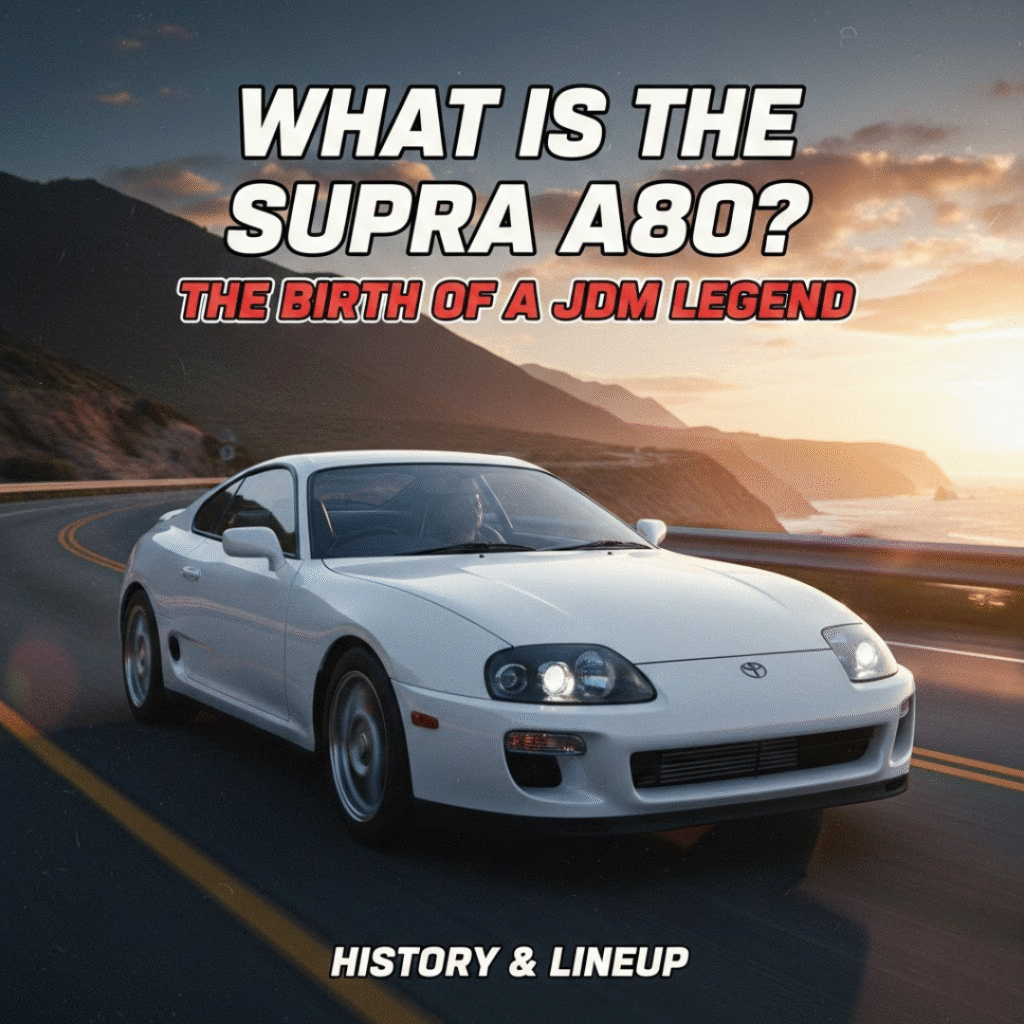
The Birth of Toyota’s Ultimate JDM Sports Icon
The Supra A80 was unveiled at the 1993 Detroit Auto Show and released in Japan in May of the same year. Marketed with the tagline “The Sports of Toyota,” it was developed as the brand’s flagship performance model—a machine prioritizing aerodynamics, rigidity, and outright speed.
While its predecessor, the A70 Supra, leaned toward the grand tourer character, the A80 transformed the model into a pure-bred Japanese sports car, engineered to take on the world’s elite performance machines.
Supra Lineage and the A80’s Unique Role
The Supra’s origin traces back to the 1978 Toyota Celica XX. Over the decades, the series evolved through:
- 1st gen: A40/A50 (Celica XX)
- 2nd gen: A60
- 3rd gen: A70 (first to use the Supra name in Japan)
- 4th gen: A80 (1993–2002)
- 5th gen: A90 (2019–present)
Among these, the Supra A80 is widely regarded as the pinnacle of the original Toyota engineering philosophy—a turbocharged inline-six, a robust chassis, and a driver-focused FR layout. Toyota engineers themselves have stated that development of the modern A90 borrowed heavily from the design spirit and proportions of the A80.
Why Production Ended—and Why the A80 Became a Legend
The A80 was discontinued in 2002 due to tightening emission regulations—not because demand dropped or development reached a limit. If anything, the A80 ended at its peak, securing its status as a classic JDM icon. The model’s disappearance coincided with the decline of large-engine JDM sports cars (like the R34 GT-R and FD3S RX-7), making it even more revered among JDM Cars enthusiasts worldwide.
Design & Engineering: Why the Supra A80 Looks and Feels So Special
Muscular and Timeless Exterior Form
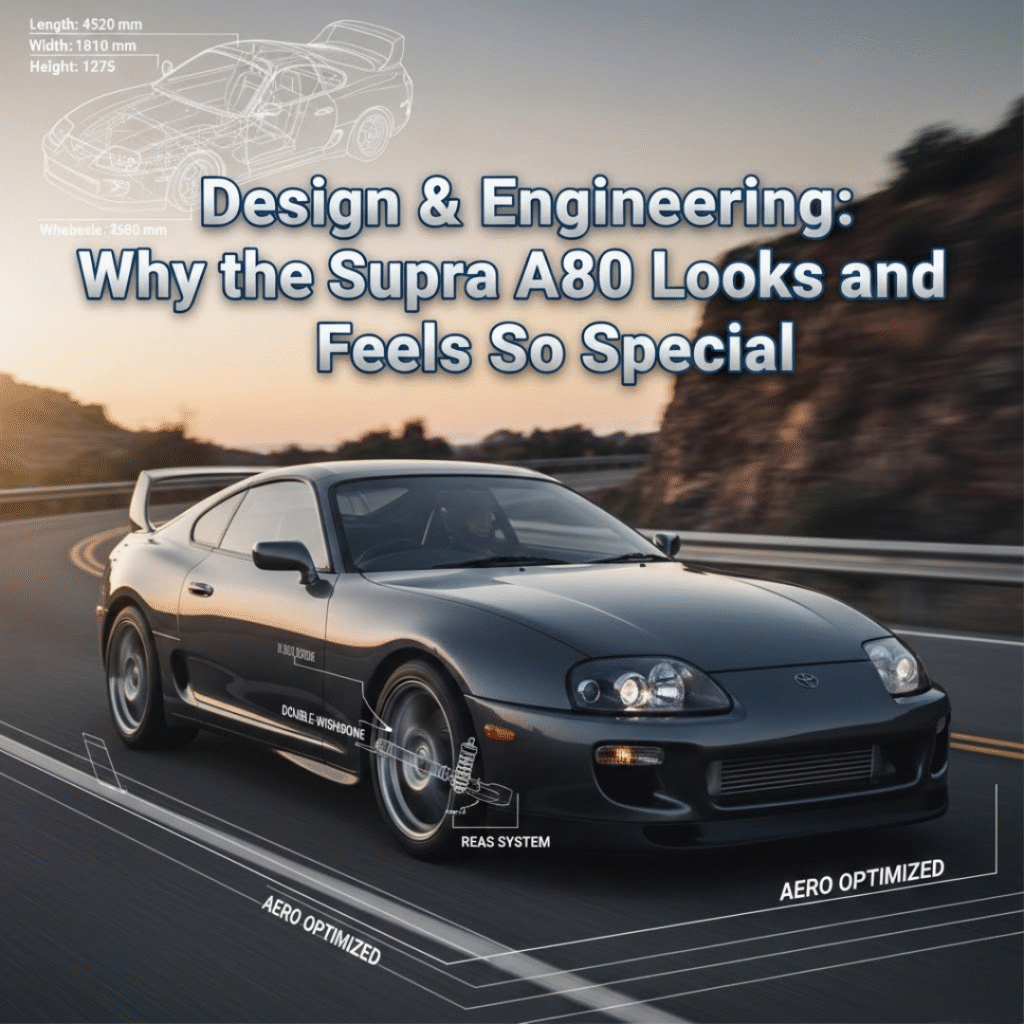
One of the A80’s most defining features is its dramatic, muscular silhouette. While the A70 had sharp, angular lines, the Supra A80 adopted smooth curves, wide fenders, and a flowing coupe profile that looks modern even today.
Dimensions:
- Length: 4520 mm
- Width: 1810 mm
- Height: 1275 mm
- Wheelbase: 2550 mm
The signature optional rear wing and aggressive stance helped cement its association with street racing culture, especially after the car’s famous appearance in the Fast and Furious movie franchise.
Aerodynamics Built for High-Speed Stability
The A80’s designers spent extensive time in the wind tunnel. Components such as the front spoiler, underbody panels, and rear wing were optimized to reduce lift and improve stability. At high speeds, this translated into exceptional straight-line confidence—one reason the A80 was favored for both drift car builds and high-speed tuning.
Suspension, Brakes, and the REAS System
Underneath, the double-wishbone suspension at all four corners provided superb handling precision, a rarity in 1990s Japanese domestic market performance cars.
In the 1997 facelift, Toyota introduced REAS (Relative Absorber System), developed with Yamaha. This mechanical cross-linked damper system:
- Minimized body roll
- Improved cornering balance
- Enhanced high-speed stability
Combined with optional big brake kits (including Brembo components on some markets), the A80 offered a dynamic package far ahead of its time.
Powertrain & Performance: Why the 2JZ Engine Became a Legend
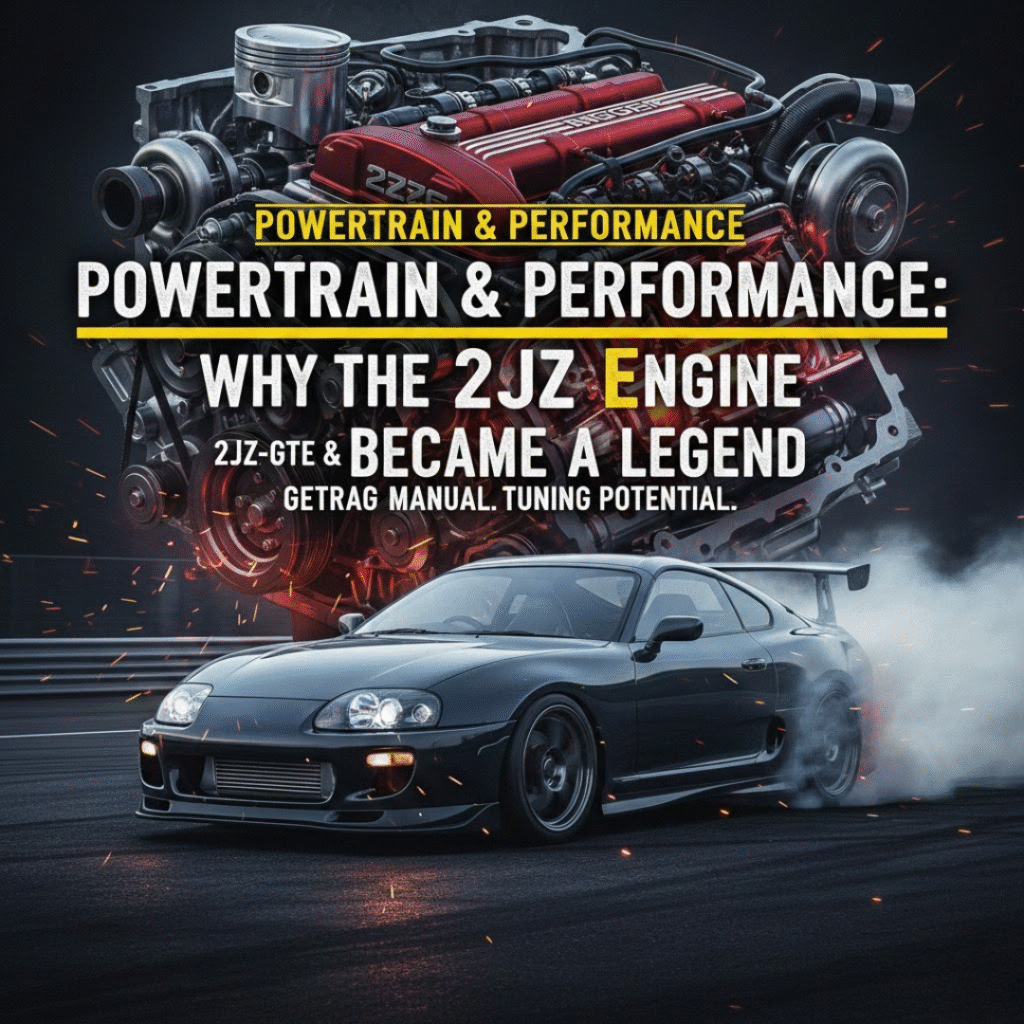
2JZ-GTE and 2JZ-GE Engine Overview
The Supra A80 offered two variations of Toyota’s iconic 2JZ inline-six engine:
2JZ-GTE (Twin-Turbo)
- 280 hp (Japan)
- 431–451 Nm torque
- Twin-turbo setup
- Famous for tuning potential to 600–1000+ hp
2JZ-GE (Naturally Aspirated)
- 225 hp range
- Smooth, linear power delivery
- Lighter front-end feel
The 2JZ block’s strength is so renowned that it has become a foundation for extreme builds worldwide—from drift cars to drag machines—cementing its place as the ultimate performance tuning engine.
Getrag 6-Speed Manual & 4-Speed Automatic
High-performance models came equipped with the legendary Getrag V160/V161 6-speed manual transmission, praised for durability and precision. NA models received either a 5-speed manual or 4-speed automatic, while later SZ-R models gained their own Getrag 6MT tune.
In today’s used car market, manual transmission models carry significant premiums and are more desirable among collectors.
Real-World Performance Figures
- 0–100 km/h: ~4.9 seconds
- Top speed (delimited): over 250 km/h
- Fuel economy: 6–9 km/L in real conditions
Even by modern standards, the A80 remains quick and highly capable, especially considering its robust chassis and powerful turbocharged inline-six engine.
Supra A80 Grades & Variants: Understanding the Lineup
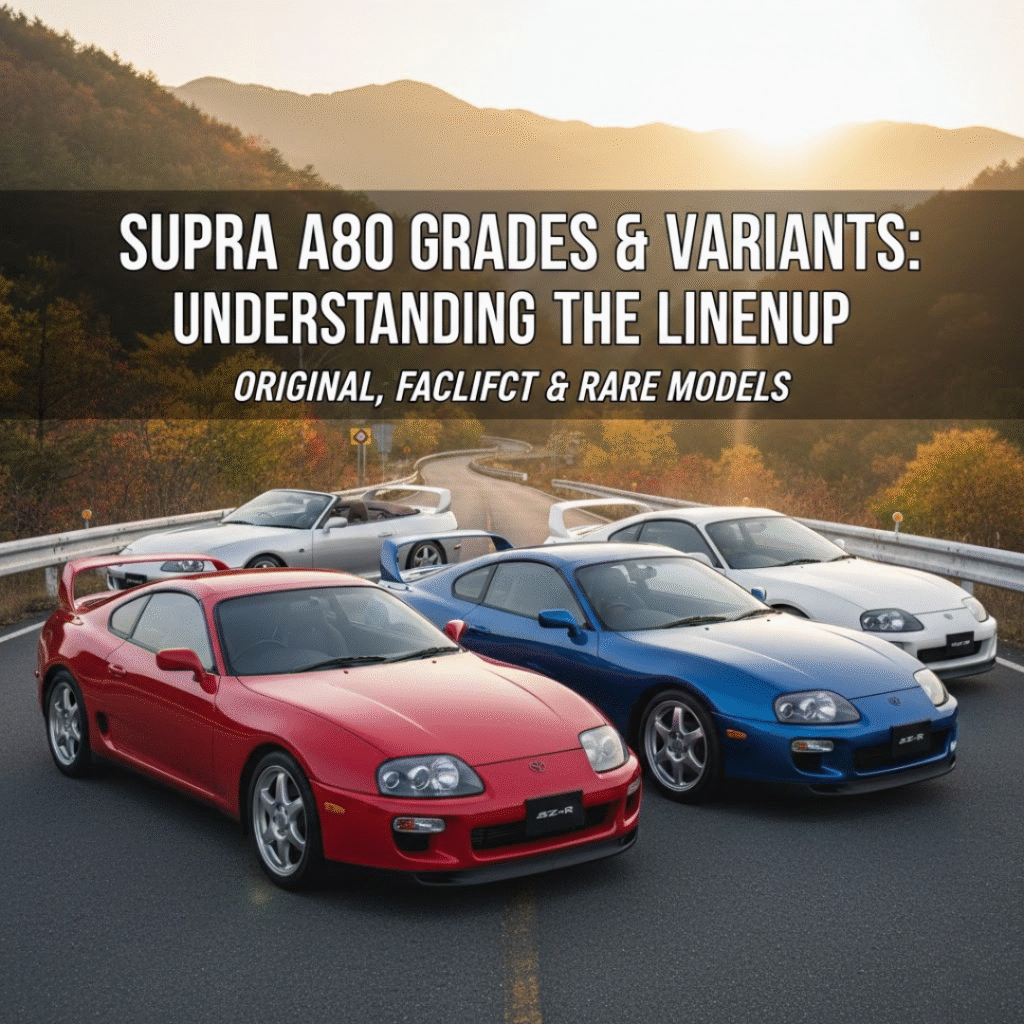
Original Grade Structure
Upon release, the A80 lineup included:
- SZ — NA engine, 5MT or 4AT
- SZ Aero Top — NA with removable roof
- RZ — Twin-turbo, 6MT or 4AT
- GZ — Luxurious twin-turbo AT
- GZ Aero Top — Twin-turbo with removable roof
The Aero Top variants, especially turbocharged ones, are extremely rare today and highly valued as limited production models.
Later Added Grades: RZ-S and SZ-R
Facelifts added:
- RZ-S — Lighter, simplified twin-turbo model
- SZ-R — NA, MT-only, later fitted with Getrag 6MT
The SZ-R in particular appeals to purists for its lighter nose and crisp handling—an ideal base for aftermarket parts upgrades or as a driver’s NA coupe.
Which Grade Is the Best Choice?
If maximum performance and collectibility are the goal:
- RZ (6MT)
- RZ-S (6MT)
- GZ Aero Top (extremely rare)
If driving feel and balance matter more:
- SZ-R (6MT, especially facelift models)
- Clean-condition SZ
Given today’s limited supply, focusing solely on turbo models can greatly delay purchase timing. Condition now matters far more than grade.
Current Used-Car Market: Prices, Availability, and Trends
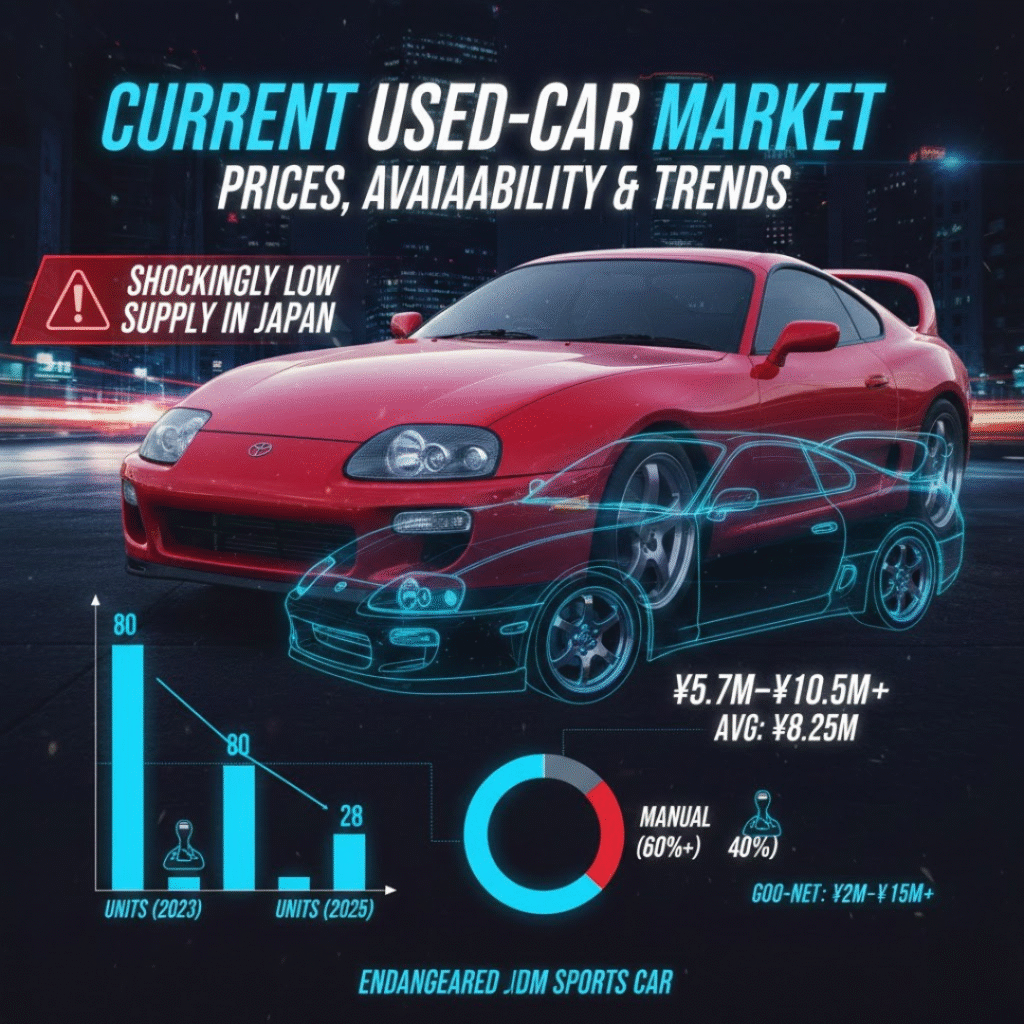
Shockingly Low Supply in Japan
Between 2023 and early 2025, the number of used Supra A80 units in Japan dropped from roughly 80 listings to just 28 nationwide. The trend strongly suggests the A80 is becoming an endangered JDM sports car.
Price Trends and Transmission Ratio
Recent market observations:
- Average price: ¥8.25 million
- Total range: ¥5.7M–¥10.5M+
- Manual transmission: 60%+
- Automatic transmission: 40%–
By grade, SZ is the most common, while RZ and SZ-R follow. GZ and Aero Top models border on non-existent.
Other Market Listings (Goo-net, etc.)
On broader platforms like Goo-net(Japanese website), the price range extends from ¥2M to ¥15M+, especially when including:
- Imported LHD units
- Highly tuned examples
- Show-quality restorations
International markets—especially the U.S.—value the Supra A80 even higher due to demand and cultural impact.
How to Choose a Supra A80 Without Regret

Don’t Over-prioritize Turbo vs. NA
In an era where the supply is extremely low, insisting only on a twin-turbo RZ may lead to an endless search. Enthusiasts aiming for reasonable timelines should adopt a broader perspective—a clean NA can be just as rewarding.
Non-negotiable Checklist
When shopping for a Supra A80, prioritize:
- Originality (or near-original)
- Interior and exterior condition
- Full maintenance records
- A thorough test drive to check for mechanical issues
A well-maintained NA is often a better purchase than a poorly modified turbo model.
MT or AT? Choosing Based on Lifestyle
While MT models provide higher resale value and involvement, AT models excel in ease of use, comfort, and price. The stigma against AT Supras has decreased as overall supply diminishes.
Mileage: Not as Important as History
Given the car’s age, even 150,000 km should not disqualify a candidate. What matters more is:
- Regular oil changes
- Proper warm-up habits
- Quality of previous ownership
- Absence of prolonged storage without maintenance
How to Enjoy the Supra A80 Today & Understanding Future Value

A Global Icon Through Film and Video Games
The Supra A80 gained massive worldwide fame after appearing in the Fast and Furious franchise, becoming synonymous with street racing culture and modern JDM Cars. Popular racing games like Gran Turismo further entrenched its reputation.
The Tuning Potential Is Practically Unlimited
The 2JZ-GTE’s robust construction allows:
- 600–1000 hp builds
- Drift and drag-specific setups
- ECU tuning, turbo upgrades, and suspension overhauls
This adaptability is why the A80 remains a favorite among aftermarket parts builders and motorsport enthusiasts.
Long-Term Ownership and Restoration Value
Owning a Supra A80 today means curating a piece of automotive history. Many Japanese collectors and professional drivers emphasize restoration as a way to preserve the car’s legacy:
- Full repaints
- Interior refurbishment
- Suspension restoration
- Engine overhauls
These projects deepen the bond between the owner and the car.
Future Market Outlook
Given the rapid decline in supply and global demand, the Supra A80’s value is likely to remain strong or appreciate. As emissions regulations tighten and pure analog sports cars fade, models like the A80 become treasured artifacts of the golden JDM era.
A Supra A80 Is More Than a Car—It’s a Lifetime Companion

The Supra A80 is not simply a fast car. It’s a masterfully engineered symbol of Japanese automotive excellence—a fusion of styling, performance, and cultural impact.
At the same time, the used-car market for the A80 grows more competitive each year, with limited availability and rising prices. To secure the right car:
- Prioritize condition over grade
- Seek originality and comprehensive service history
- Understand the car’s long-term value and maintenance needs
If reading this article made your heart beat a little faster, you may already be halfway to becoming a Supra A80 owner. Take your time, search carefully, and eventually, the perfect machine will reveal itself.
And when it does, you won’t just be buying a car—you’ll be inheriting a JDM Cars legend and writing a new chapter in your automotive life.